 As I get up in the morning, I feel rather nervous and uneasy. I am not quite sure why. I am to sneak off from the conference I am attending to catch Manchester United against Bournemouth, and from there I am heading off to Huddersfield for my first two-matches-in-a-day-experience in England.
I am not sure what the nervousness and uneasiness is about. The sneaking away from the conference? I did my presentation the previous day, but I feel I ought to attend the presentations of good colleagues and friends. Next the United match. I have to store up my suitcase at the station – and I always feel uncomfortable about that for some reason. Next, for only the second time in four months United have the chance to break into the top 5 with a win. Last time they blew it with a frustrating and disappointing scoreless draw against lowly Hull at home. Are we destined to do it again? Three weeks ago, the photographer from the United Review took photos of Dale, Thomas and me with Lou Macari and Bryan Robson. Will they be featured in the match programme today?
After the match. I will have 70 minutes to get back to Manchester Piccadilly, pick up my suitcase and catch the train to Huddersfield. It is quite a few years since I have tried to be in the rush after a match to get on a train to the city centre. I have been based in Chorlton for every match the last four years and therefore been walking to the ground – and anyway, for most matches I have stayed around the ground after the final whistle. Will I make it? And my second match? Plenty of things to worry about.
I have breakfast early at the hotel, hoping I won’t meet anyone and have to explain that I am choosing the football over them. But the Spanish girl Noemi is there, and we have breakfast together. She is to present on a French sports cartoon hero, Michel Vaillant. I later discover that it is in fact a motor racing hero, dubbed Mark Breton in the Danish version, which I read on a weekly basis in my childhood. When I discover it, I feel even worse about skipping the session. Noemi is from Madrid, and I love the way she pronounces Real Madrid. It sounds much better than the Danish and English ways. I have to go some day. I explain that although I ought to support Barcelona having family there, there is more of a connection between United and Madrid than between United and Barcelona – and that the press image of Barcelona as the purists and good guys annoy me. She knows what I mean, but then she runs through Franco’s and the system’s allegiances with Real, and I am reminded why I really ought to support Barcelona.
Anyway, I get on the train and get to Manchester. There are quite a few people queuing up at the left luggage counter, which is quite worrying. All of them are going to the match and will have to pick up their luggage at the same time as me. Fortunately, most people opt out of the queue for some reason, probably having the same anxiety as me, but with a clear-cut idea of an alternative. Well, I haven’t got one, but because others seem to do, it is quickly my turn. “Allow 15 minutes for pick-up” the guy tells me. My train leaves at 15.41, meaning I will have to be back at the station at 15.26 – with the match due to finish around 14.20. That gives me about an hour.
I move on to get on the metro. The queues for the ticket machines are long, and the first train for the ground leaves the crowded platform. Fortunately, a woman turns up selling event tickets to the ground for cash only, and I manage to get on the second train. It is still almost 2½ hours to kick-off, but the train is pretty full. It adds to my feeling of unease. If the trains are pretty full going to the ground at this hour, they will be packed for more than an hour leaving the ground after the match. I have some regrets that I have packed in two matches on the same day. Normally, at this hour, the metro is just about the most quiet place you can be. People on their way to work are quiet and focused, but everybody seems to be talking on the way to the match. It is incredibly noisy.
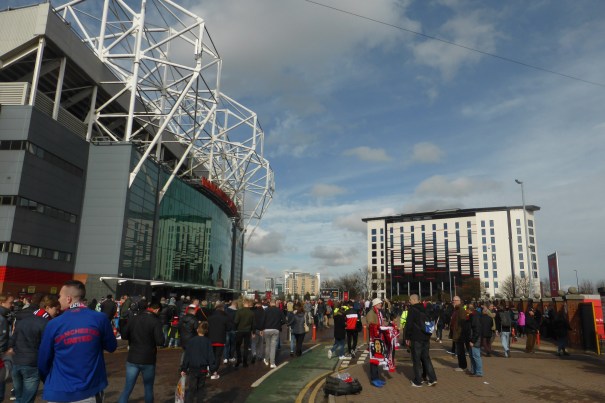
 Getting off at Old Trafford Metro stop, however, eases my mind. Running the gauntlet among grafters that today not just offer matchday scarves for tourist but “Ibra” or “Zlatan” scarves as well – as well as a few ticket touts who by this hour when the police are out in full force have decided to move from the stadium to the station, I get this sense of home again. The walk up the Warwick Road passing all the stalls, The Trafford Bar which reopened only three weeks ago after curiously being shot down for 3 or 4 months, and finally the row of shops along Chester Road which look pretty much the same as they did the first time I came here about 40 years ago. The Red Star Souvenir shop on the corner, the Lou Macari Fish ‘n Chips and all the other grill bars.
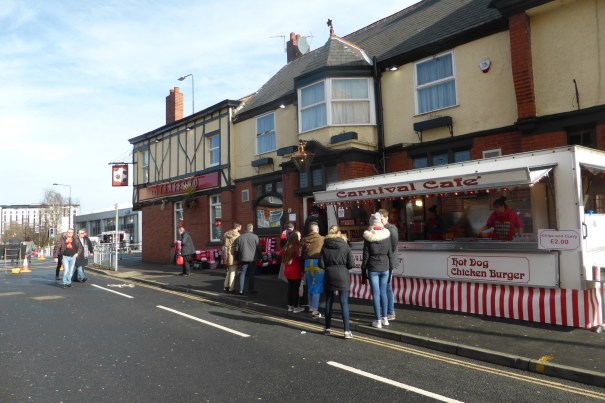 Normally, I would go straight to The Red Star to say hello to my friend Angelo, but today I head straight to the ground to buy the match programme. Immediately, I browse through it to see if there is a photo of us in it. There isn’t. It feels a bit flat. I had promised to buy copies for Dale as well, but no need for that now. I make my way back to Angelo’s.
As I enter, Angelo’s wife Lisa sees me and smile. Angelo is busy displaying some United trainer shoes to a man. The inside of the box is an inside photo of the ground. Impressive. Angelo asks me about my thoughts on his latest business idea. A 3-D scanner, where visitors can be scanned, attached to a 3-D-printer that can print a statue of them, with Eric Cantona standing next to them, his arm around their shoulder. Of course, people would have to pay, but wouldn’t that be a great idea? I am a bit skeptical. “It depends on how much they have to pay. I say”. One thing is to get your wife to accept you spending time and money to travel to football matches. But to come back with an even more expensive statue to stand in the living room, well that could well be the final straw that will see the end of several marriages.
 As I leave the shop, I come to think of another reason, why I wouldn’t do it. I was keen to buy the match programme because there might have been a photo commemorating a fantastic day at Old Trafford, actually meeting Lou Macari and Bryan Robson. It is the actual meeting that I somehow want to extent by having some memorabilia from it. How would it feel to have a statue with Eric Cantona without even meeting him? Well, I did briefly see Eric some ten years ago, when he was the patron of the football world cup for homeless in Copenhagen. And he smiled and nodded approvingly, as I asked him to sign my ticket for the 1994 FA Cup final, in which he scored United’s two first goals. But a statue produced in this way would not commemorate that meeting. Instead, I imagine, it would lead to some embarrassing situations. Having memorabilia is basically about story-telling. When people see my old authentic player’s shirt with Bobby Charlton’s autograph, I can tell them both the story of how then United manager Ron Atkinson presented it to me, and how I got Bobby Charlton to sign it. But I wouldn’t be able to tell anything from such a statue. In fact, I would have to explain that we actually didn’t meet, but it was made in a shop. Finally, I have always found it a bit smug to have paintings let alone sculptures of yourself.
But it may be of interest to the same sort of event-seeking fans who also purchase matchday scarves. From Angelo’s shop, I go straight to the chippy. Alas, it is not the same lady who is usually there, and who saw us filmed by MUTV three weeks ago. So my plan to ask for a free meal in return for the good advertising I have given them, seem out of place. I go to the usual house opposite the Bishop Blaize to eat it. The Bishop Blaize is one of the pubs where United fans gather for a song and a drink before the match. But you sense that it is still early hours. The singing is not as loud as normally.
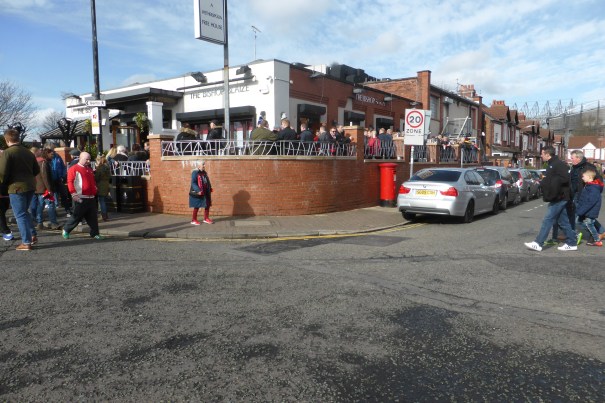 There is a convenient garden wall that makes it up for a table, although I feel a little guilty every time using somebody’s frontgarden in this way. I am careful not to drop anything, but other less careful fans may get inspired to take up the position. As I dump my tray in a container on the corner of Chester Road, I spot the lovely lady with the Zlatan scarf who I met outside the Cricket Ground the other day. She walks along with a young man talking, but whereas he continues, she goes to the doormen regulating entrance of fans into the Blaze. She talks with them for quite some time, before walking away.
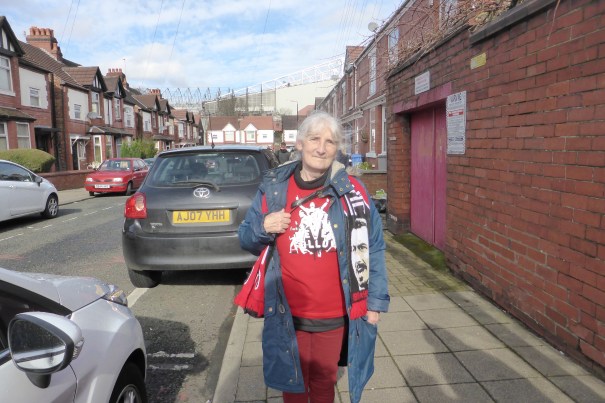
I walk after her and tap her on the shoulder. “Hello – we met the other day”. “Oh, you remember me!” she says. Of course, I do. She displays her t-shirt under the jacket. Marlon Brando has given way to a drawing of United players. I take a photo of her in the new outfit. She had tried to get inside the Blaize as she wanted to join the singing inside. But she hadn’t been able to persuade the doormen to let her jump the queue. But she loved the singing. She asks for my match prediction. Normally, I am very cautious. Cocky predictions always come back to haunt you. But somehow I feel I have to be optimistic to make a good impression on her, so I go for a 3-1 win. “Oh, do you?” She is sensibly more cautious and go for a narrow 2-1 win, but adds that it is about time we take our chances and give somebody a hiding. As she walks down the road, she starts talking with a couple of men. It does look as though they are going to the match together, but on other hand, she would be talking with anybody she met.
Lifted by this meeting, I take a walk around the ground. I buy the Red News and United We Stand fanzines. I really miss my favourite one, Red Issue. After almost 30 years and some fantastic stunts such as unfolding the “Manchester is Red”-banner on the Kippax stand for Manchester City’s last match at Maine Road, and a 19-times-champions banner at Anfield, they called it a day last year, allegedly because they felt that they had become to mainstream. Today, though, a brand new fanzine hits the road for the first time. “1878” it is called. It is a nostalgic view on the good old days and, of course, I buy that one as well.
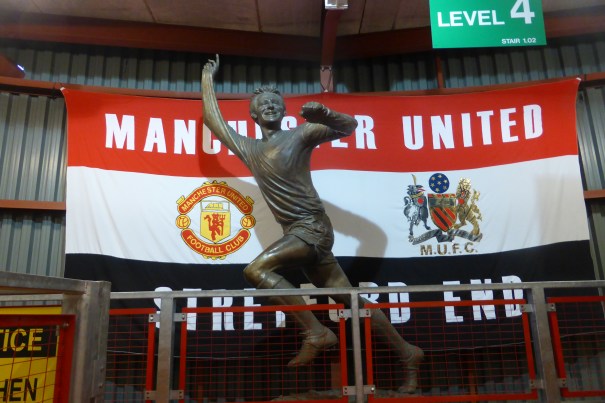 Afterwards, I head for the Stretford End. I take a walk around and watch the MUTV giving the team news and pre-match analysis with Borjan Djordic. As far as I can remember, he only played one or two matches for us some 10 or 15 years ago. I need a drink, and as I only had a bowl of cereals for breakfast, I am not completely full after my fish ‘n chips an hour earlier. So I am tempted by a 3 item offer that will give me a twix bar for the train ride, a drink and an opportunity to taste the “United Pie”. Steak, cheese and fiery chili in a shortcrust pasty base. I only eat half of it, but almost feel sick. I am glad that I don’t have to go on the pitch.
 There is something about early kick-offs that is not quite right. You have not quite got the pulse up for the match. And quite often, not all the players have. For United, this is obviously the case for Zlatan and Pogba. Or maybe they have had the same problem as me in trying to fit in breakfast and prematch meals before 12.30, and feel just as bad. At the same time, Jones, Rooney, Shaw and Carrick make their first starts for a long time and all seem rather rusty, particularly Jones. In some ways, I identify with Jones. Whenever he makes a clumsy challenge, is turned by an attacker and left struggling for pace, whenever his touch is heavy, or he is caught out of position, I think “that could be me”. In some ways, it is nice to be able to identify with a player, but I prefer United playing central defenders who do not remind me of myself. Jones is lucky to get away with an early slip. But I do feel uneasy. United have all the position and – despite the rustiness and early morning blues – take advantage of some poor Bournemouth defending to create a string of chances, but fail to score. The atmosphere is quite ok. The strange thing about Old Trafford is that when you are standing in the Stretford End, there is almost non-stop singing going on all around you. But somehow the acoustics of the ground with 75.000 bodies covering the concrete, and with the roof almost like a sound bell pressed down over the Stretford End, you can’t hear it at all if you are sitting in another part of the ground.
With United looking rusty at the back and seemingly playing their keeper warm with a string of saves, the uneasiness creeps back into me. But, we do eventually go one goal up, and that makes me relax. Surely, now, Bournemouth have to come forward in the second half, and Mourinho will put on Rashford and his pace to exploit the space. But five minutes before halftime, Jones’ rustiness makes him give away a penalty with a clumsy challenge. That was not in the script. 1-1. A double incidence involving Zlatan leads to chaos and the sending off of a Bournemouth player. Surely we will win against 10 men in the second half, considering the string of chances we have created against 11. But there is still an uneasiness, well merited as it turns out.
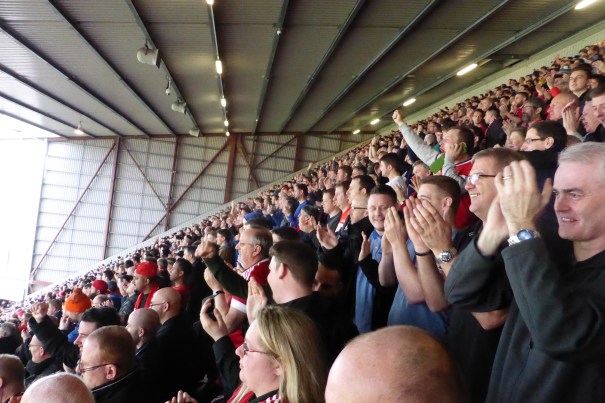 Gradually this uneasiness grows to impatience in the crowd. Bournemouth players keep going to the ground for treatment, making the crowd upset, and this seems to spread to the players. And the keeper is master at timewasting. All the good moves of the first half disappear. Now we just seem to go for the quick long ball to Zlatan, but that is leading us nowhere. 18 minutes from the end, we do get a penalty. I am right to the middle of the pitch, looking directly down at the penalty spot. Surely, this will sort it for us. The lady in front of me, dare not look, but turns around. Her anxiety is proved right, as the keeper gets down to save it. Now the frustration around the ground is so thick that you can cut through it with a knife. And it gets to the players, so when Pogba gets two guilt-edged chances in injury time, he scuffs them. The performance turns out to be like the chili in the pie, not very fiery after all.
 I feel absolutely sick as I climb down the stairs of the stand. I have prided myself that United have won all matches, I have attended in the post-Ferguson era. 13 matches. And then that run is ended by 10-men Bournemouth! When a win could have lifted us into top 5. I decide that rather than building up more frustration in endless queues for the metro, I will walk to the Piccadilly. According to Google maps, it is a 68 minutes’ walk. I do have 70 minutes. I have to allow time for the luggage, but I think I can speed walk my way out of that. But I forget that 75.000 people flooding out in the streets make speedwalking rather difficult. At first, I plan to cross the railroad via the bridge next to the Stretford End. But the crowd queuing up to get on the bridge seems to be standing still. So I walk through the Munich tunnel. The crowd is moving, but very, very slowly.
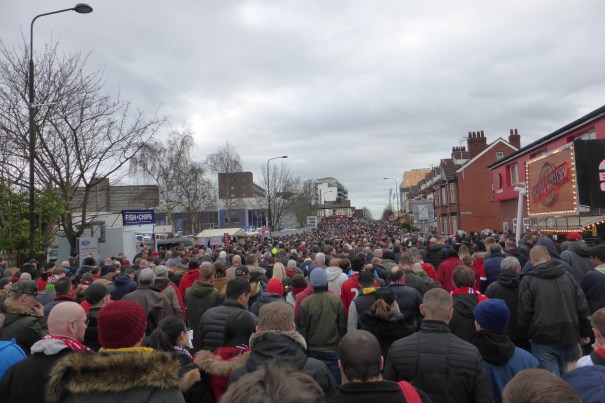 As I eventually get through and hit Warwick Road where the fanzine sellers are back in position, I see my new lady friend talking with one of them. Once again, I tap her on the shoulder, she grasps my hand and shakes her head in frustration, but says some words that I can’t quite hear in the din of the crowd, but she appears to be upbeat. I instinctly grab a card from my pocket and hand it to her. Chances are that she is not the emailing type, and will never drop me a line. But I am somehow intrigued by her, and would dearly love to spend a match day with her, as she walks around the ground, chatting with people and trying to get to a sing-song.
Rather than continuing down Warwick Road, I turn left down Chester Road. At least we are at normal walking pace now, but it is difficult to overtake people. It is not until the Trafford Bar Metro station that I can hit full speed. All along the way, there are scattered groups that have opted for the walk back to town just like me. And when I get a glimpse of overcrowded trams inching towards the city center, I am glad I have the opportunity to vent my frustration by some exercise.
I get to station after exactly 60 minutes, with ten minutes to train departure. Fortunately, there are only three people in front of me at the luggage pick up, and I do manage to get on my train in time.
Knowing that I would be short of time, I have booked a room in the hotel, which on google maps looked most convenient for a stop enroute from Huddersfield station to the ground. “The New Huddersfield Hotel” it is called. That sounds good. But “new” turns out to be a bit premature, as it is very much work in progress. The receptionist seems surprised that a guest turns up at all. Having checked that I have made a reservation, he asks me to follow him. It would have been impossible to explain the way around several corridors and stairs, half of them looking like a building site, and the place apparently empty apart from the two of us.
I am reminded by a 1970’s episode of “The Persuaders”, where Roger Moore as Lord Bret Sinclair thinks he is in hospital. But then finds out that he is kept by villains in an empty country house, where they have furnished a single room to look like a hospital and kept him drugged with a hospital-soundtrack in the background to fulfill the illusion. Somehow, this looks like a similar deception.
In my room, I can hear the singing of Newcastle United fans, who swarm outside the pub that is next to the hotel. Room without view and wifi but with match day atmosphere outside. My shirt is sweaty after the speedwalking, so I change and hurry outside.
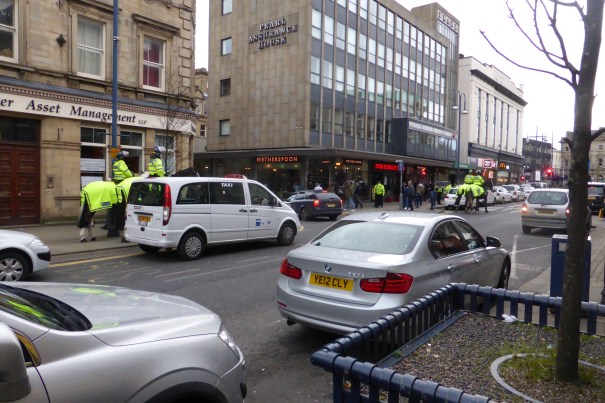 There is quite a lot of police in the streets, preparing to take on the Toon army. But there does not seem to be any trouble. There is steady flow of people walking towards the ground. So if I had any doubts as to the whereabouts of it, they would quickly have been repelled. Anyway, I have several times looked down on The John Smith Stadium from the train running through Huddersfield. It is located down in a valley, so the direction more or less gives itself. Downwards. On the way, I pass a car that serve as an old programme stall. All profits, it says, are to an Alzheimers and heart foundation. Which remind me that Sporting Memories actually does some great reminiscence work. This is another way of helping out.
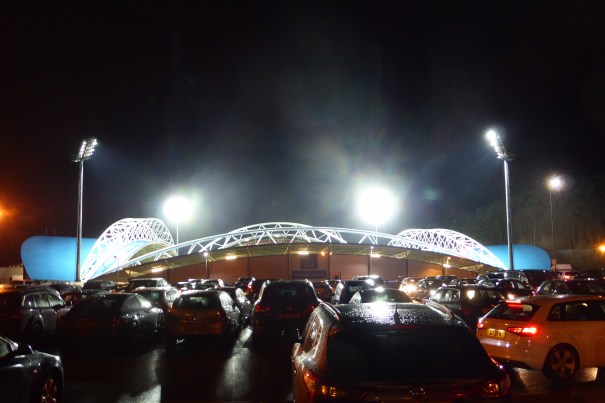
 I am full of anticipation (but still sick at United’s draw) as I head towards the ground. The John Smith Stadium belongs to one of the first new stadiums after the Taylor Report in 1990 (although Huddersfield apparently had been contemplating a move even before that), and it distinguishes itself by being an architectural award winning stadium. Whereas most other grounds from the early 1990’s before the money got really big were at best functional and nothing else, this was designed to be inviting as well.
 Like most grounds at the time, it is not built as a bowl but consists of four separate stands. The special thing about it is that the stands are not square but rounded and sort of tied together by some impressive white floodlight pylons. It looks more like some futuristic octopus-like underwater world from a 1970’s movie than a football ground. Only two of the stands were built, when the first match was played in 1994, the north and south stands first being added in the following three years. I wonder what that may have looked like.
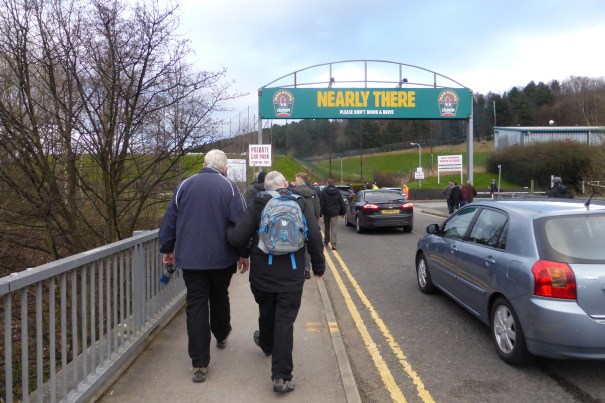 There are several car parks incorporated in the complex. “Nearly there” a giant sign proclaims. Not only the 20 or 30 coaches or so with Newcastle fans but also a lot of the locals are parked right next to the ground.
 When I arrive, it is only 25 minutes to kick-off, so there is not that much time to walk around the ground and take in the atmosphere and little details. Most people seem to be in a bit of a rush to get inside, and I find it difficult to dwell on what I see. Maybe this is why, I find it surprisingly barren. There are no statues, no memorials. The only two elements inscribing some element of history are a sandstone ornament from the Huddersfield Cricket Club of 1874, and two gravestones. The two latter ones are both for Rugby players, Ronan Costello and Dave Valentine.
Mark, the curator at the Manchester United’s museum, who lives in Huddersfield, told me that when Leeds Road was demolished, he asked the curators at the local museum if they had done any collecting to document the history of the club and ground. They hadn’t. “Huddersfield does not have any history of importance”, was the answer. To which Mark had replied that they were only the first club to win three successive league titles back in the 1920’s. There is no trace of the history either in the souvenir shop. No books on the club’s past.
Instead of something to commemorate the history, there is a fitness center and a giant “Odeon – fanatical about film” behind the ground.And a guide to watching the bird life by the river.
Inside the ground, the stairways and the concourse all look nice and stylish, but it is too crammed with people. Somehow, they have got the dimensions wrong, certainly compared to other more modern grounds. I am still feeling full after my double prematch meal at Old Trafford, and although the pies look tempting, I decide just to have a drink.
Inside the ground, I see to my horror that each seat has a clapper attached, just like the King Power stadium at Leicester. I really hate the noise they make and they seem to me to be a modern marketing colsutant’s attempt at reviving a fading atmosphere. Strange, because in both previous matches I have seen Huddersfield – at Bolton and Preston – they have had an excellent away support. Great numbers, vocal and with some great chants. At Preston, they kept going till they went 3-0 down – and although they by then got a little more quiet, they were still as noisy as the home fans. Why would they need clappers here?
 This is not the only ‘foreign’ fan element, however. There is a touch of latin Ultra to it, with blue and white boards being held up in the air by the Huddersfield fans behind the goal, they wave some gigantic flags, and in my section, the air is full of confetti before kick-off.
To my surprise, it is the home fans doing the singing and chanting prior to kick-off, and not the famous, travelling Toon army from Newcastle. I am seated almost right next to them, in the corner of the ground, so I can see their faces. I grab the opportunity to do two stadium counts rather than one – one for the home fans and one for the away fans. As for the home fans, it is pretty much average, with 98% white 86% male crowd. The Toon army, though is 99% white and 93% male. But then travelling to away matches is not really a family thing.
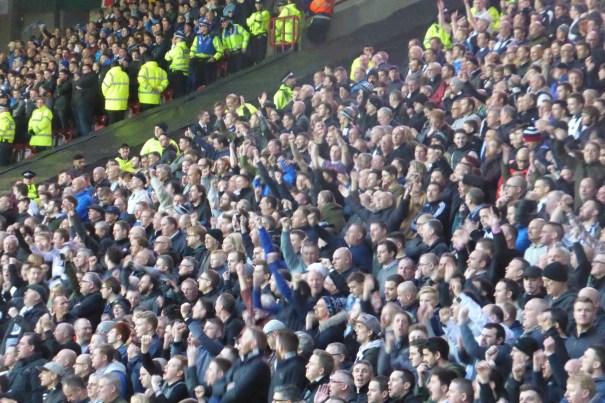 Although there is this “Huddersfield Ultra” section behind the goal, most of the ground join in on some of the chants. And all the ground take part in the oohs and aahs. It really is a passionate atmosphere. In my section, close to the Newcastle fans, a lot of the fans are preoccupied by the visiting fans. People are standing, shouting, chanting, and gesturing towards the visitors. Right in front of me, a Huddersfield fan has brought his girlfriend with a spectacular hairstyle along to the match. She is a bit upset that she has to stand up to be able to see anything. But some 10 minutes into the match, he spots that the two seats to my left and the two seats in front of them are still vacant, so they move up next to me, enabling her to have a fair view despite sitting. Further to my left, all fans are seated.
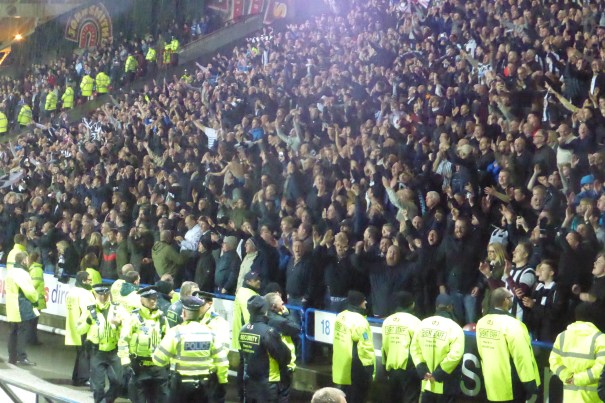
An Away End Erupts
Newcastle are top of the league, and they look very solid and confident. After less than 10 minutes they are awarded a penalty. The Huddersfield fans think it is very soft, and maybe rightly so. I am not quite certain. But now I have the perfect opportunity to film “an away end erupt” – a chapter in one of my favourite football books, Daniel Gray’s “Fifty Delights of Modern Football” (my other favourite books being Dave Robert’s books on “32 programmes” and “Home and Away” with Bromley in the Vanamara league).
 Newcastle score, and the Toon army gets a boost. But – the Huddersfield fans don’t go quiet. They chant to rally their team. Although Huddersfield have a lot of possession and put in a lot of effort, spurred on by the crowd, Newcastle seem to me to have the match under control. After some 35 minutes, a Newcastle player tackles the ball away from the Huddersfield keeper as he dives to pick up a long cross in the penalty area, and the Newcastle player rolls the ball into the net. The keeper is furious, so are the Huddersfield fans. They hurl the clappers towards the pitch. The woman with the hip hair next to me is hit by one, and her boyfriend, who has been busy hurling abuse towards the referee and linesman, now directs it to the crowd behind us. One of the policemen down by the corner is filming us, detecting and documenting offenses. The stewards grab one or two of the fans closest to the field and issue a warning to them.
 Maybe it is the sense of injustice, but the Huddersfield fans seem even more up for the match now. The fan with the girlfriend next to me wheels his arms in the air as he tries to get a “Hud-ders-field, Hud-ders-field” chant going. In the second half, Huddersfield enjoy even more of the possession, and they do put together a couple of decent attacks. However, it takes a penalty 12 minutes before fulltime to bring them back into it. The fans in my section go wild with even more gesturing towards the Newcastle fans. You would have thought that Huddersfield were winning by now, judging from that.
Huddersfield fans celebrate
The fan next to me shouts out something that sounds like a mixture of “magpies” and “maggots” towards the Newcastle fans, laughs diabolically, before assuring his girlfriend that he doesn’t even know what it means. You sense that there may be a way back in this for Huddersfield after all.
 As the match enters injury time, Huddersfield win a corner. Their keeper comes up for it, but has to make a hasty retreat, as the corner is cleared. Huddersfield do win the ball back, but the keeper is still way outside his penalty area, as a Newcastle clearance is belted up field. The keeper runs to head the ball forward, but somehow he mistimes it, and the ball skids of the top of his head as he falls to the ground, leaving the ball to a Newcastle forward who can just walk it into an empty goal. The Huddersfield fans are stunned into silence, whereas the Newcastle fans go mad. Several of them tear off their shirts and wave them in the air. I am wearing my winter jacket as well as thermal underwear and am still freezing by now. But not the Newcastle fans (and to be fair, there are also Huddersfield fans around me wearing only a short-sleeved replica shirt). I spot a boy of no more than five or six years of age in the Newcastle section. He is sitting on his father’s shoulders and has also taken off his replica shirt. Like the hard core fans, he is also waving his shirt, bare wasted. I wonder if his mother would approve, if she knew.
 That’s it. The final whistle, and the Huddersfield fans curse their luck and their keeper as they leave the ground. I take a quick look around outside to see if there is anything I missed before the game. But in the darkness, I don’t really see anything new. I make my way back towards the city center. Police escort a long line of coaches with Newcastle fans towards the highway. By now, only scattered groups of Huddersfield fans are walking towards town.
 Finding a place to eat in Huddersfield on a Saturday night without having reserved a table turns out to be difficult. I ask for a table in the first half dozen of places, but they are all fully booked. So I have to settle for a 20 minutes wait at “Nando’s”. I have some chicken and rice and a glass of wine. Afterwards, I head back to the strangely abandoned hotel. The receptionist is still there, but in a world of his own listening to music in his earphones. Apart from him, the place seems empty. I get to my room and turn on the television to see the football highlights.
Match of the day focuses on the Zlatan incidence. A Bournemouth player trampled on his head, apparently deliberately – then Zlatan clearly elbowed him. Not surprisingly the match of day crew argue that the trampling could be accidental, whereas the elbowing couldn’t, so United had been aided by the referee. They also argue that the first booking for the sent-off Bournemouth player was a bit harsh, and that Zlatan went to the ground too easily when he was pushed over for the Bournemouth’s player to get his second yellow card. To top off their argument, they point that the United players got him sent off, because the referee initially overlooked that he already had booked the player. Well, the embarrassing thing about that is that all officials overlooked it – and deliberately pushing a player in the chest Is an offence whether you go to ground or not.
I turn off the telly and go to sleep, but I am woken up at about 3 A.M. Some men are banging on a door, trying to wake up somebody sleeping somewhere in the building. It is, in a sense, comforting that there is somebody else here after all. But I can’t fall back to sleep. The bed is so short – no more than 180 centimeters, and it is so shaky that whenever I move, it makes an alarming sound.
I finally decide to get up at 6.30 and go looking for somewhere to have breakfast. I want to have a shower, but discover there is only a bathtub. Well, I have a bath and go downstairs. There is nobody at the reception, only a sign asking to leave the keycard in a basket. I do that, and go down the main street, hoping to find somewhere they serve breakfast. The only place, however, is McDonalds. I gather there must be something at the station, and go there.
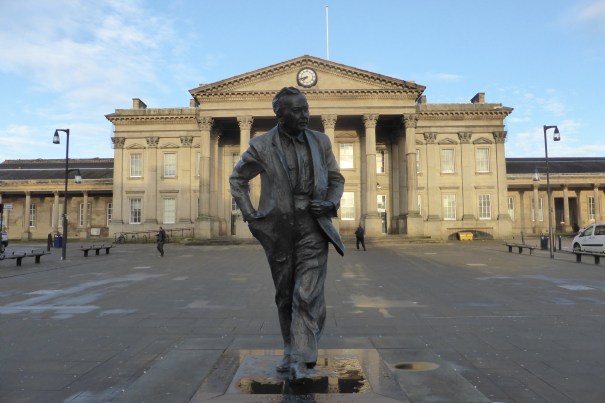 They may not have any statues outside the football ground, but there is one outside the station. Harald Wilson, the former prime minister, apparently was from Huddersfield. I also notice that the pub “The King’s Head” in the station complex has a portrait of Jimi Hendrix underneath, although I can’t quite come to think of any connection between Hendrix and Huddersfield. I enter the station to start on the next adventure: a trip to the Stadium of Light in Sunderland.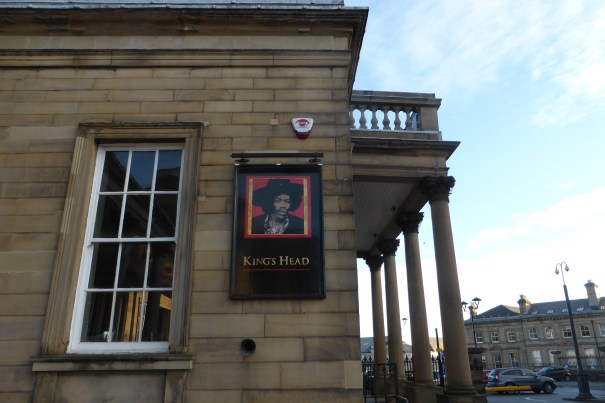
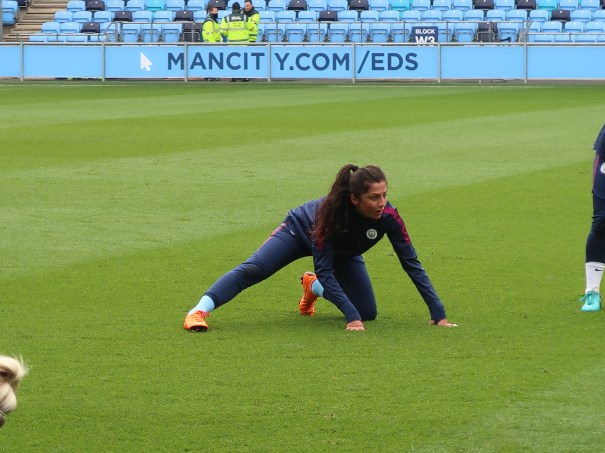

 On my way to the UK, I have read the anthropologist Mariann Vaczi’s book on Atletic Bilbao, in which she makes a strong case for the Atletic women’s team playing their matches at the San Mames Barria stadium – just like the men’s team. But instead, they play at an academy ground in a mountain village. “A visit to a women’s game reveals that futbol femenino is embedded in a feminized rural context as opposed to the tough masculinity of urban competition”.
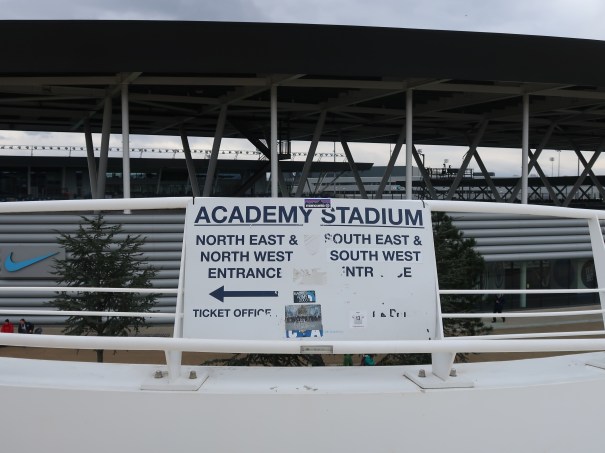
 At least the Manchester City Academy Ground and the Etihad are part of the same City of Manchester complex, built for the Commonwealth Games in 2002. But apart from being much smaller – the capacity is 7,000 compared to 55,000 – the Academy Stadium does not feel like a proper football ground. And you could argue that there is a similar difference to the two grounds as the one Vaczi points out.
 One of the characteristics of a great football stadium is the ability to create the atmosphere of “a world apart” – a theater of dreams, where you are completely absorbed by the matchday experience. A total immersion. The Academy Ground seems to be deliberately striving for the opposite. It seems intended to be a transparent space as opposed to a closed and mystical shrine.
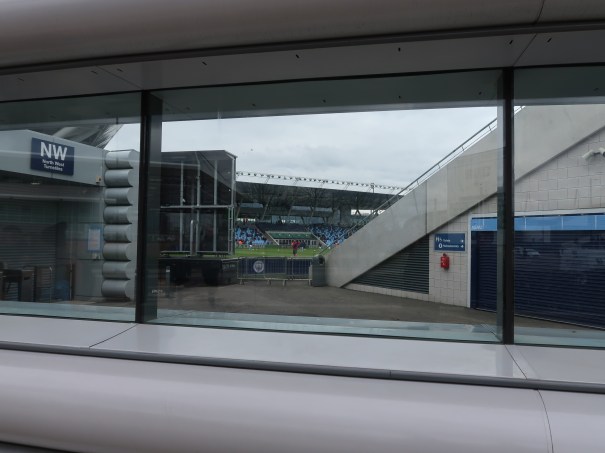 There are huge windows in the corners of the ground; and in three of the four stands, the roof is floating high above the outside walls, allowing the noise of the passing cars to dominate the soundscape. It seems like something conceived for a desert stadium. Fresh breezes are invited into the ground to cool spectators seeking shadow – not shelter – under the floating roofs. Well, no need for that in rainy Manchester.
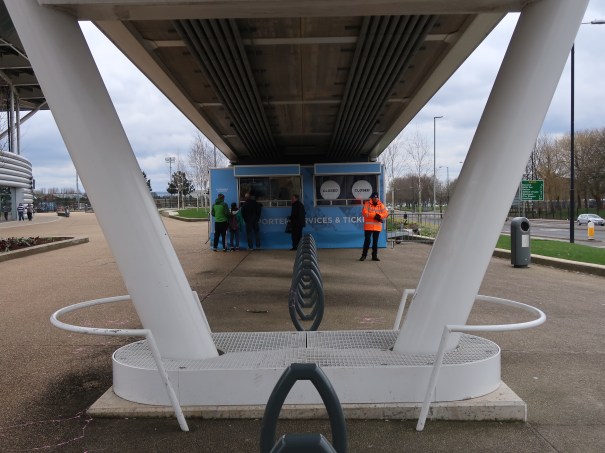
 Vaczi mentions two arguments for Atletic’s women playing at the academy ground. The first is costs. It takes a lot more staff to operate a big stadium compared to an academy ground. That City wish to cut down staff expenses for the Academy ground can be inferred from the self-service ticket machines outside the ground. First time I have seen such a thing at a football ground, although to be fair, I bought our tickets at the small, staffed ticket office just outside the ground. Given the millions Manchester City splash out on players, however, it is difficult to imagine that City can’t afford the staff necessary to operate the Etihad for a women’s game.
 The second argument from Atletic is the psycological effect it may have on the players to play in a stadium with more than 90% of the seats empty. Just as the self-service ticket machines might indicate that it is an issue of cutting down staff costs, the coloring of the seats inside the Academy Ground might indicate that a horror vacui – or more precisely fear of empty seats – may be at play.
 It is not unusual to use different colored seats at grounds. They stand out in order to write sponsor names, club names, or even to form club crests or portraits of club legends across the empty stands. But here, the apparent random use of grey seats among the sky blue ones only seems to be a disguise of empty seats. The crowd is just over 1,200 – and apart from some 40 standing behind one of the goals, everybody is packed in the main stand with no access to the opposite stand. So the policy is to pack a stand as much as possible – at the cost of leaving the others empty. With a 7,000 capacity, the ground is almost 20% full. Compared to 2% if it had been played at the Etihad.


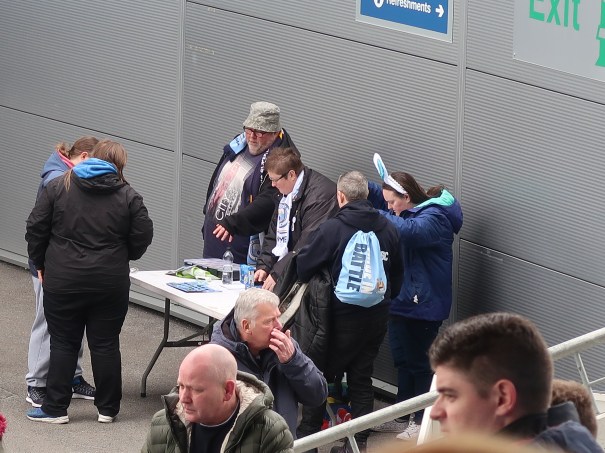 A small group of City fans did their utmost to generate an atmosphere. They sold souvenirs from a desk (maybe it was a one-off that the Manchester City shop at the Etihad was closed for the match – due to Easter – but it seemed strange), they handed out clappers to the audience, and as the match got under way, they took up position fairly close to us with a drum.
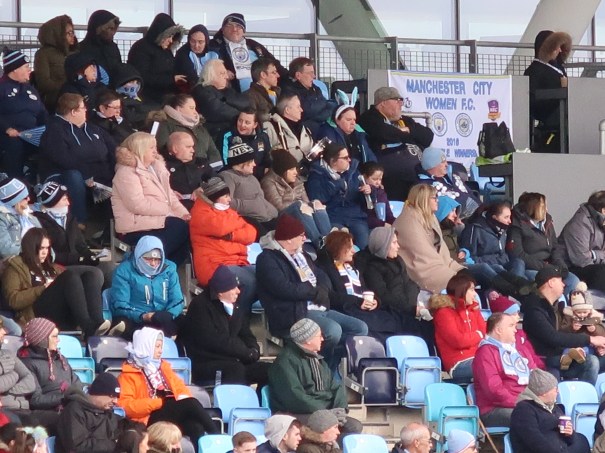 For those who have read my previous blog posts and my posts in the facebook group on football grounds and stadia, it is no secret that I am very annoyed with drums at matches – as well as clappers. To me, they basically ruin atmosphere rather than generate it. The special thing – to me – about British football, is the way the ebb and flow of the match are expressed by the crowd. How the noise gradually rise as an attack is building up – to culminate in a collective sigh or roar. Drums do not follow the flow of the match. If anything, they are a response to it. Sometimes – after a chance has been missed – the drum is used to get a chant going. Other times, the drum is used to get a chant going as nothing is happening on the pitch – and everything has got disturbingly quiet. And then, if by chance a promising attack is set up in the middle of the drumming, you don’t really get the response to it from the crowd. In the first half, City do get a sudden break, but the crowd seems preoccupied with the drumming, rather than raising the noise level to strike fear into the defence and encourage the attacking players. The game is lulled into the same, predictable rhythm of the drum.
 I know that some people will argue that my perception of a good atmosphere is gendered. One of my friends in Manchester went for her first match at Old Trafford during the 2010 Olympics – a women’s game. She told me and another of my friends – a male City supporter – that it was so great. Whenever a player excelled, all the crowd cheered, no matter which team she was playing for. We looked at her in disbelief. “But you have to support one of the sides”, we tried to explain. As she just answered that they didn’t, we insisted that they missed the point of the match. That you are taken for an emotional ride that may end in despair – or jubilation. That is the essence of football. But she had had a great time anyway. Of course, I also know women who are just as passionate about their side as I am – or just as “hot fans” as some researchers call it. But there may be a case for arguing that the matchday culture at men’s matches basically has been developed by men and is gendered.

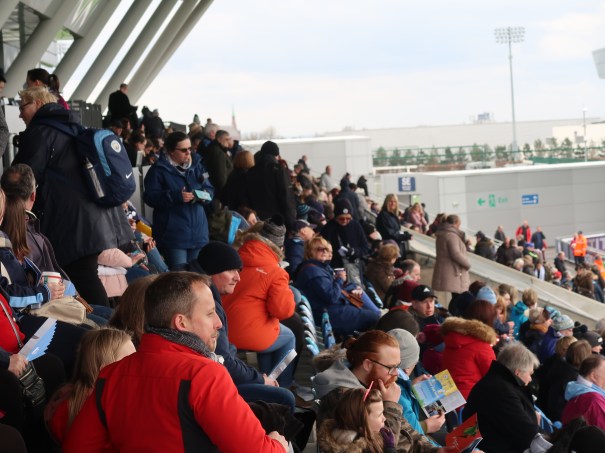 Still the small section around the drummer tried to get some chants going, but whereas they did manage to get people to use their clappers to accompany them at the start of the game, it just grew more and more quiet.

 For the second half, we went to the standing terrace behind one of the goals – along with some 40 others. On a cold day, it is much easier to keep warm when you are standing. But the noise of the cars was more disturbing there.
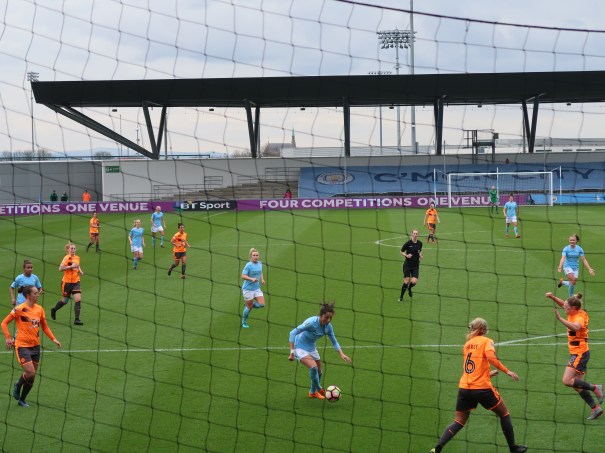 Just before Reading doubled their lead from a corner, City put on Danish striker Nadia Nadim, and the cheer-leading group responded with a “We’ve got Nadim, Nadia Nadim” chant. And she did add some much needed movement in the City attack with a couple of good runs into space behind the defenders. Alas, it seemed that her teammates are not used to look for her runs. She did get into a number of finishing positions with one shot blocked, one shot wide and one shot saved.
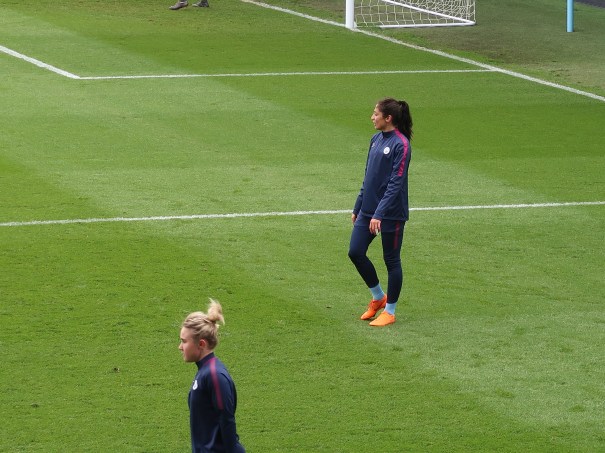 Normally, I am quite sceptical about Danish players. No matter how they play, Danish media always hype them and claim that they were decisive for any success their club may enjoy. But I really like Nadim. Not just because she is a cool person, making the transition from Afghan refugee to medicine student and professional footballer. She is also the type of player who offers you something unexpected. The type of player that can raise a crowd in anticipation of something special when she gets on the ball – and that is also essential for generating a good atmosphere.
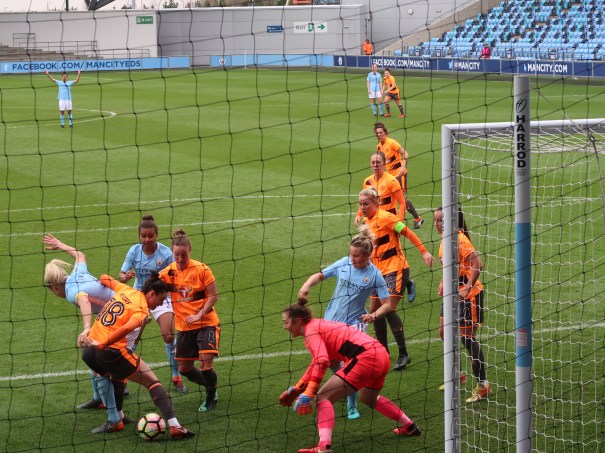 But there is no way back into this for City. Even though Reading have one of their two strong centre backs, Jo Potter, sent-off 10 minutes from the end. Impressive holding-midfielder Rachel Furness slots comfortably into central defence to keep City from creating more than a few half chances.


 Just as I arrive at Kirkcaldy station at 2 pm, I get a text from Siobhan, asking about my whereabouts. I answer that I have just arrived in Kirkcaldy. “Keep an eye on trains”, she writes, “You don’t want to get stuck in Kirkcaldy”. That message is immediately followed by another: “Just heard that every train is stopping at 3, maybe head back to Edinburgh”. In fact, Edinburgh is shutting down, and Siobhan and everybody else is hurrying back home while they still can.


 I then decide to go to Hibernian’s ground, Easter Road. There must be somebody there informing people, that the match is off. And maybe they will allow me inside to take some photos of the snow-covered pitch as a compensation for missing the match. I get to the ground. But it is completely deserted. When I visited an early morning last spring, I was stopped twice by security, as I walked round the ground to take photos. Now, all security had run off because of the snow. Hastily, it seems. Only a short, printed message on a sheet of paper in the window and on the door of the ticket office, and on the main entrance to the club reception.

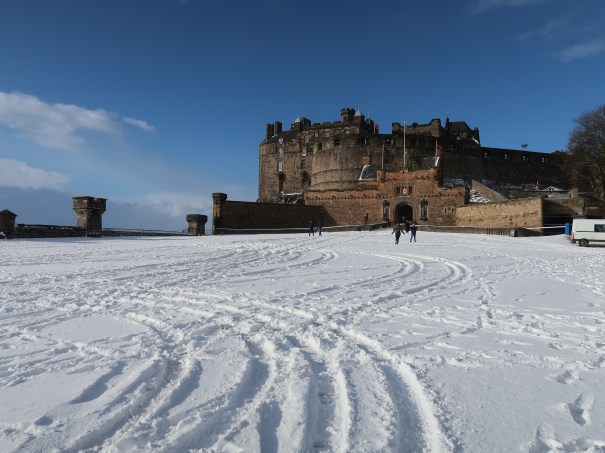 I get plenty of time to rethink this. Edinburgh is cut off from England by the snow. I spend four days in Edinburgh, desperately searching for information about the progress of clearing the railroad track of snow; slipping and sliding on the steep streets of Edinburgh in my search for a vacant hotel, carrying my bag with the added weight of the brick, as it is impossible to drag it on wheels through the snow; figuring out new plans A, B, and C to escape or find a football match somewhere.
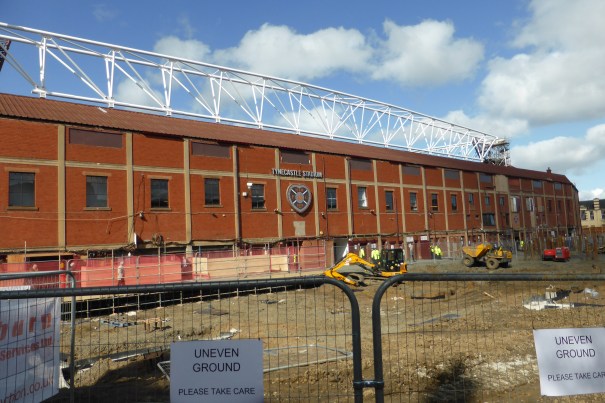

 Actually, the club has been about to leave the ground several times over the past three decades; and the future is once again in doubt at the time of writing. But it would be a disaster, if they left.
 Only the previous day, I had paid Brighton & Hove Albion a visit. A brand new stadium, built in the middle of nowhere. Despite the effort of giving an imprint of fan relations through a memorial garden, it just felt completely dead. Just off a station at Falmer – with green fields and a university campus next to it. There was no life at all.
 Fratton Park was also deliberately built close to a train station; but also in a residential area. The main stand is right in the back yard of the neighbouring terraced houses. In fact, the reason why it hasn’t quite got the proportions of a standard Archibald Leitch stand is the very proximity to the houses which limited the allowed height of the construction.
 I am fortunate that chairman of Pompey History Society, Colin Farmery, has agreed to give me a guided tour of the ground before kick-off. We meet in front of the cottage, which, according to Simon Inglis, was built in 1905, not 1898 when the club was formed and the club purchased the ground. The stadium was ready for use in the first week of September 1899 – the same week as Hillsborough, White Hart Lane, Highfield Road and Blundell Park.
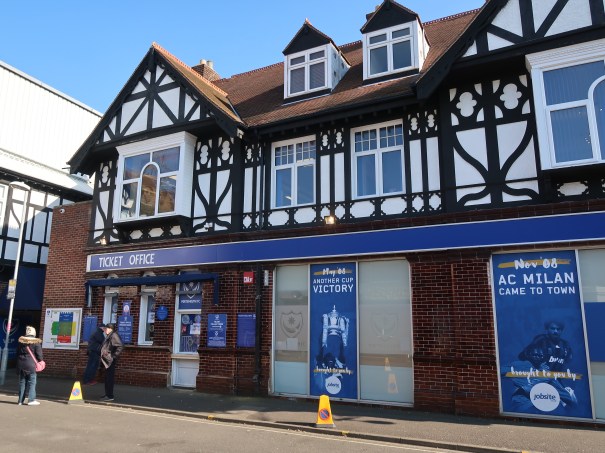 A mock Tudor pub in Frogmore Road was built in connection with the cottage in 1900. Today, the ground floor of the former pub is the ticket office, whereas the first floor is used for hospitality. Originally, the pavillon had a balcony towards the pitch, as well as a clock tower. But that was demolished 20 years after, when Archibald Leitch came along.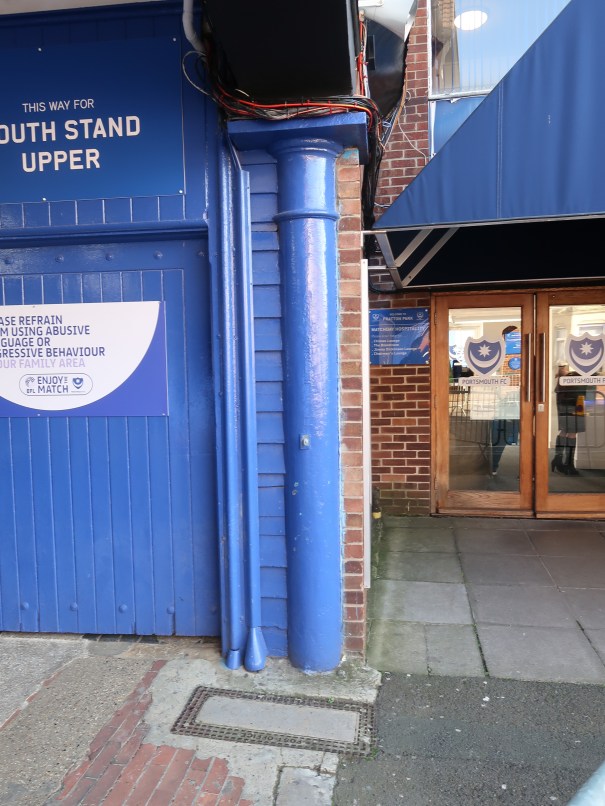


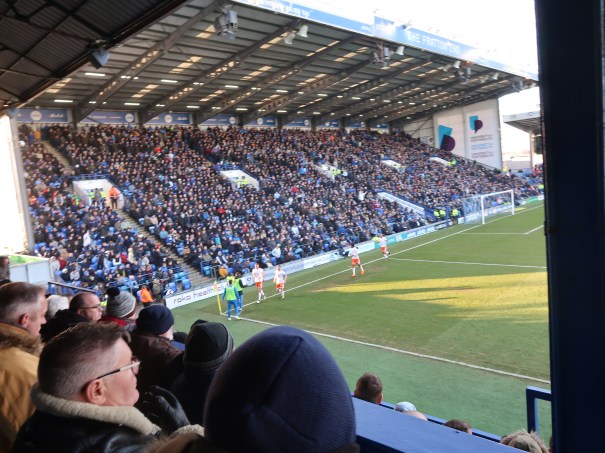


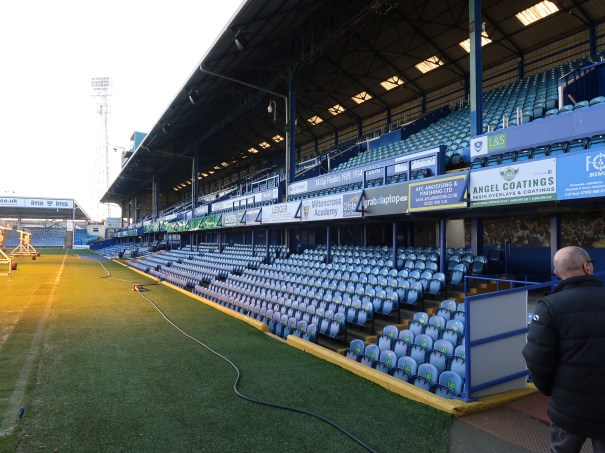

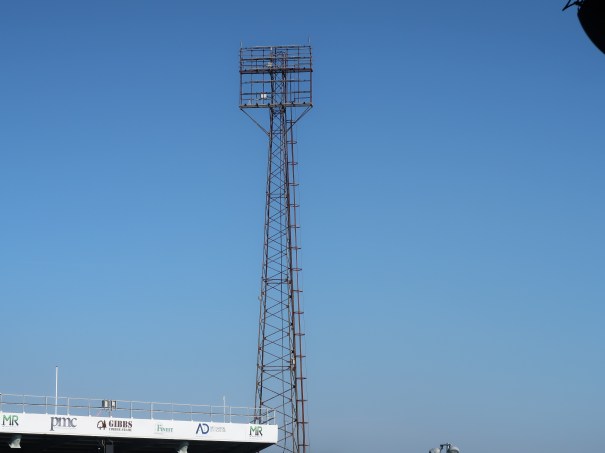


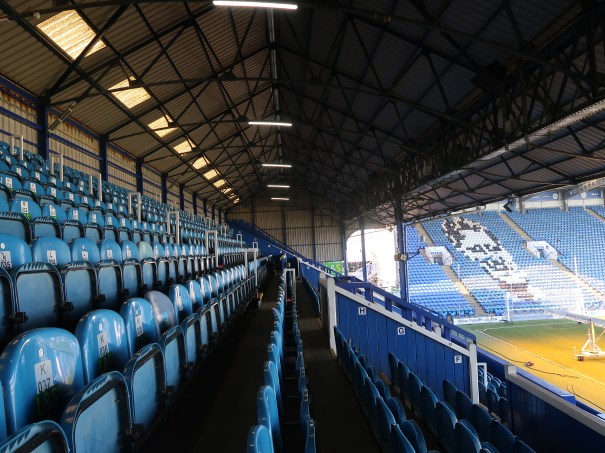

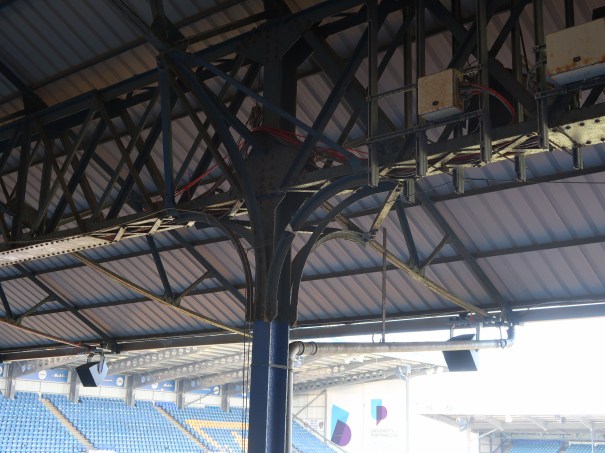


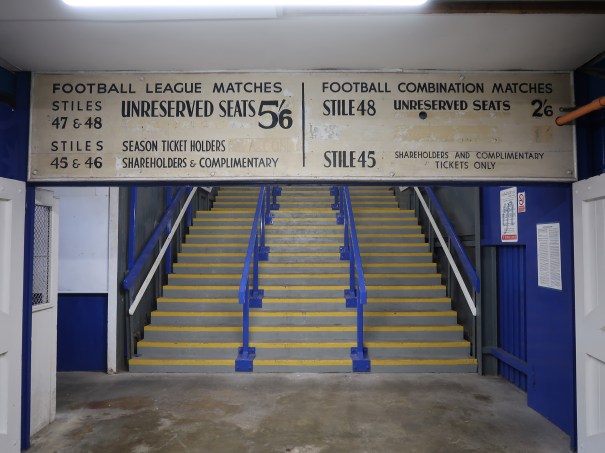


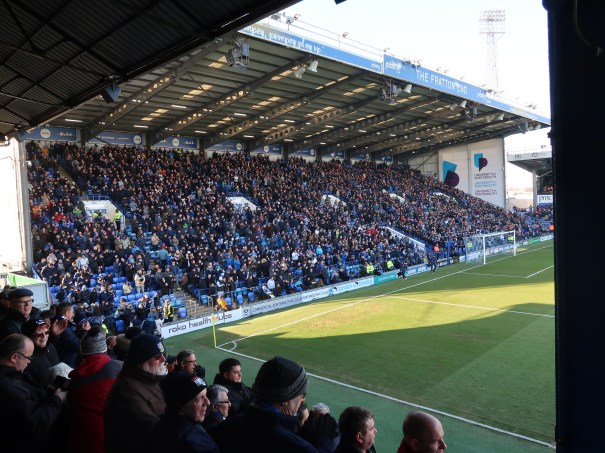
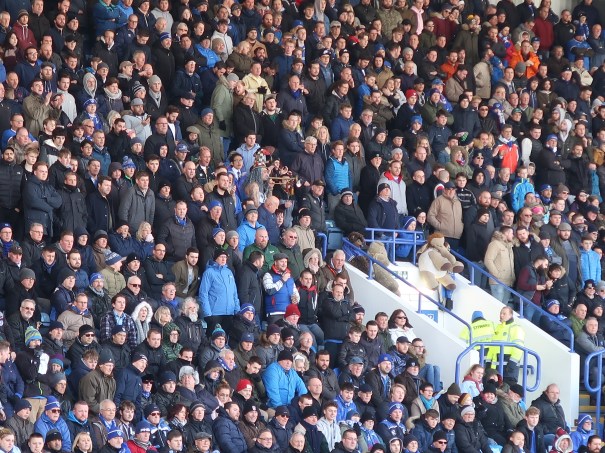




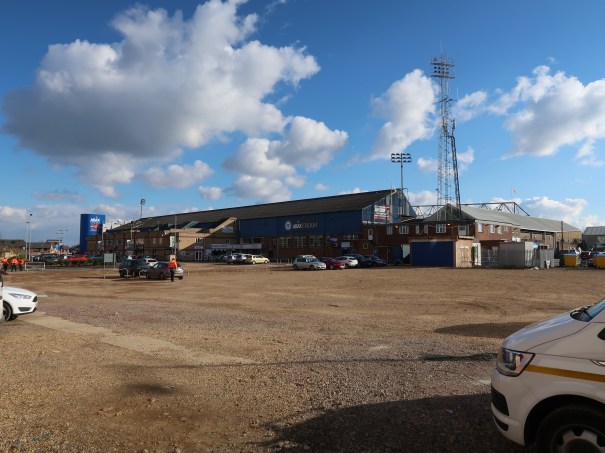 It is, perhaps, a bit ironic, that Peterborough should have an ‘old school’ football ground. The club is relatively young, from 1934, and they only won promotion to the league in 1960 – three years before I was born. The ground, though, is a lot older. It was founded by the city council in the 1890’s, but taken over by “The Posh” shortly after their formation. Since then, however, everything has changed. At the match, I chat with a supporter, who has been going for 60 years. According to him, the main stand was the only proper stand in those days. It was built behind the old wooden stand, but when that was demolished, the pitch was moved – and a terrace had been constructed opposite. But this wasn’t a proper stand. He had been going to matches ever since, so considering the amount of money he had paid for tickets, he felt real ownership to the club.
 The current main stand is from 1957 – that is, perhaps, part of the reason, why it has not been re-developed in contrast to just about any other football stand. Well, some redevelopment has taken place. New buildings and facilities have grown on the exterior. And the paddock at the front has been seated.
 I have an appointment with club photographer Joe Dent to walk round the ground and take some photos in the afternoon before the evening’s match against Walsall. As I have purchased a ticket for the remaining standing terrace at the London Road End, this is my chance to have a closer look at the stand.
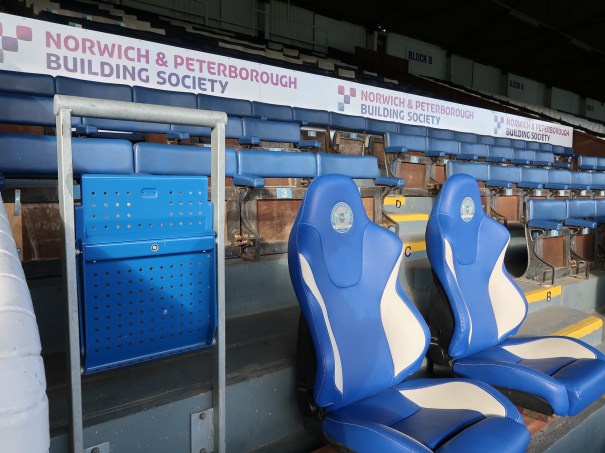 What really catches the eye are the seats. The old wooden seats are still in place. Some are painted white, some blue, to make it look like a modern plastic-seated stand. Around the directors box, seats are padded – and the front row has been replaced with comfortable modern seats.

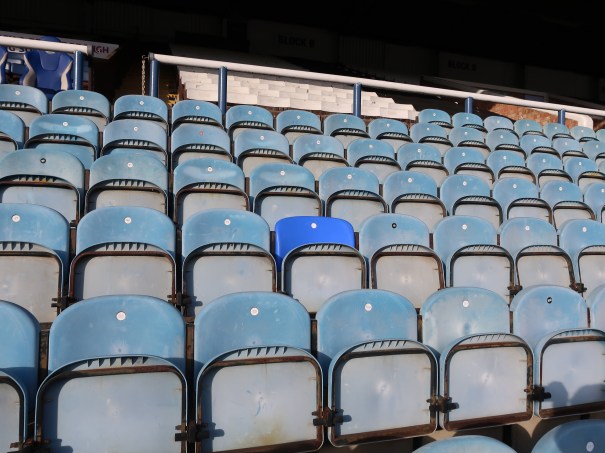 To complete the selection of seats, plastic seats have been installed in the former paddock at the front. The old discoloured blue seats are from Leicester City’s Filbert Street – and a small section of yellow seats from The Old Den at Millwall. As these stadiums were demolished, Peterborough managed to get hold of some of the seats. And when White Hart Lane was demolished only last year, they tried to get hold of some of the blue seats to replace the yellow ones. But, alas, the size didn’t fit.
 Compared to the new stand at Moy’s End, where all the plastic seats are brand new and shiny, the variety of seats add life and soul to the Main Stand. As I stand in the London Road Terrace during the match in the Evening, I look at the corner, where the two stands – 57 years apart – come together. The modern stand looks anonymous, cold and unwelcoming. The old stand looks warmer and mystically alluring.
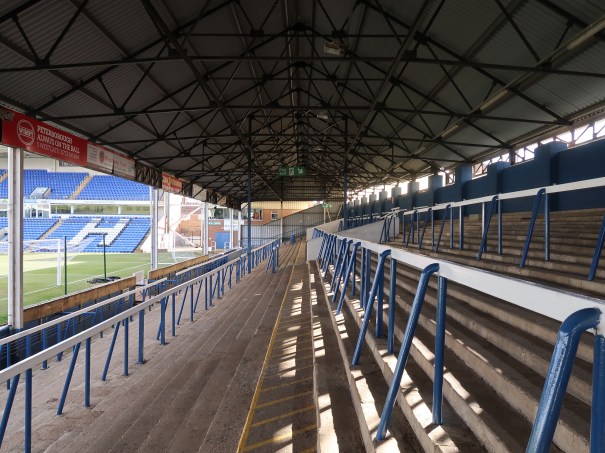 I don’t get inside to see the concourse of the main stand. And at the London Road Terrace, there is no concourse. There is a small stall outside the sheltered terrace, that is all. But who needs a concourse when standing on a terrace, especially a covered one? The rows of crush barriers are just fascinating. It is, of course, a far cry from the huge terraces of bygone days – the capacity is 2.667, that is just over 10% of the Kop at Hillsborough in its prime. It is almost exactly the same capacity as the brand new all-seater stand at the opposite end of the ground. But the number of fans preferring the standing terrace that night must be at least 3 or 4 times as high at the seated fans.
 The family stand pitch side opposite the main stand, has more character than the other new stand at the Moy’s End. It is probably the line of executive boxes cutting it into an upper and a lower section. But it also has a very slight asymmetrical look. In order to fit in behind the housing in Glebe Road, it is a bit narrower by the London Road End with space for less rows of seats.
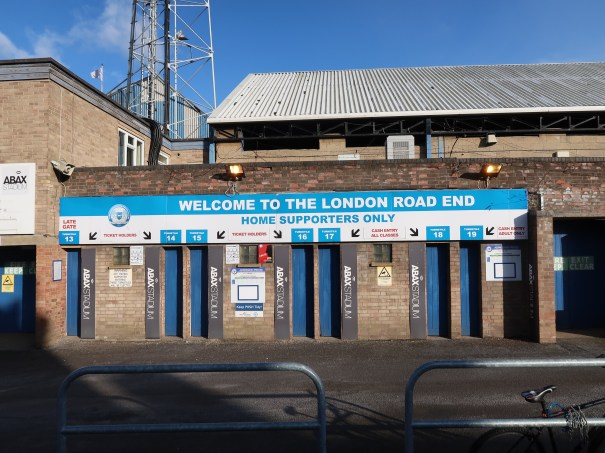 That is another feature making London Road Stadium an “Old School” ground, It is located in the town center, fitted in behind the housing. Many modern ground are built outside the center, in areas where land is cheap, and space for stadium as well as parking is plenty. These stadiums often look soulless or lifeless, whereas old school grounds have been shaped by the living community around them.
 As I walk round the pitch with Joe, I tell him about my research into memorial gardens at football grounds. It turns out that Peterborough are contemplating a garden just outside the main stand. Six months ago, they erected a statue of former player and manager, Chris Turner, who passed away in 2015. Not that statues and memorial gardens are features of ‘old school’ grounds, rather the contrary. But it is way of strengthening the historical identity of the club.
 In this sense, the new stand at Moy’s End, incorporating the “Allia Business Centre” is in stark contrast to everything else about the ground. Particularly from the outside, the sterile look of glass and blue coding make it look exactly like a business centre – and not a football ground.
 Anyway, the main stand with the multitude of different seats and restricted view as well as the terraced London Road End have won me over – as well as the hospitality. I go back to my hotel to get some warmth before the match – and spot an Indian restaurant on the way to have a hot meal as well to prepare me. As I am about to pay, the waiter asks me if I would like a brandy or a whisky. I decline, but I adds “it is on the house”. On second thought, I decide to take anything in that can help keep me warm.
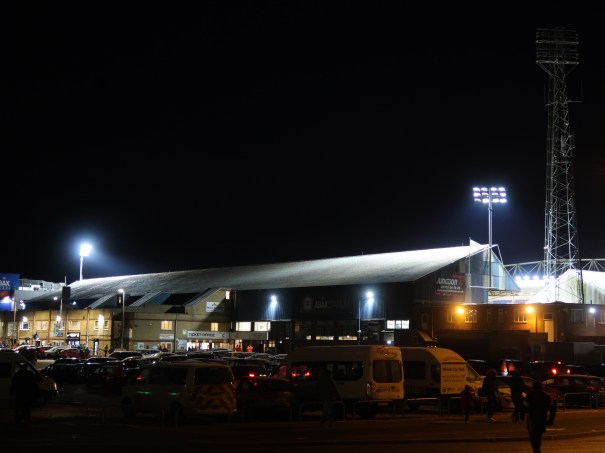 There are not many making their way to the ground. In fact, only about 2.500 brave the weather to see if Peterborough can change fortunes to the better after six straight defeats and the sacking of their manager. Some eighty are away supporters from Walsall.
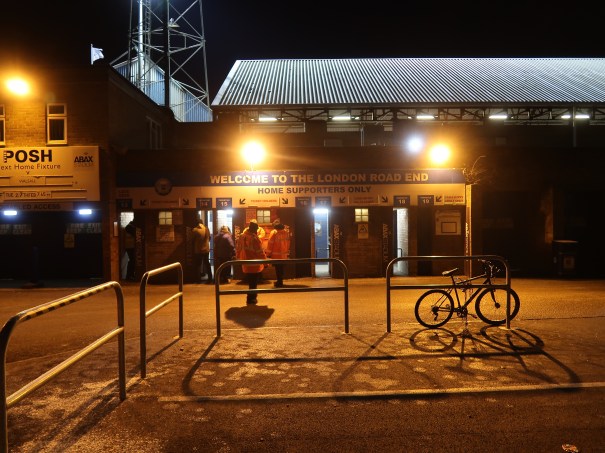 I am delighted that I opted for the standing terrace rather than the main stand with the wooden seats. It must be absolutely freezing there. On the terrace, I keep moving around. To the left side, to the right side, next to the pitch, in back row. And I am not standing still. I stamp my feet – and join into some of the Peterborough chants – especially in the second half. A several minutes long rendition of the “blue army” chant makes everybody join in, stamp their feet, clap their hands – keep warm.

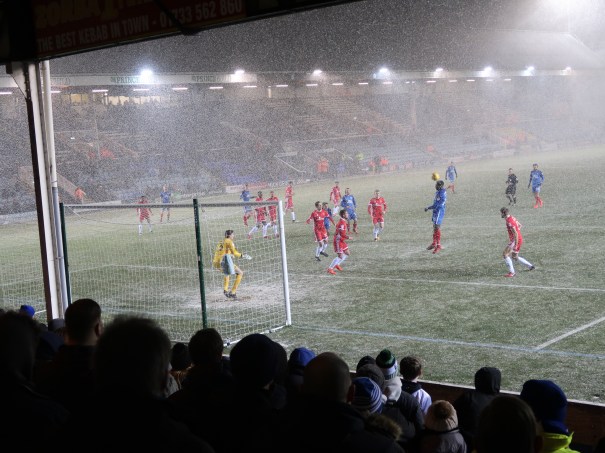 Some 10 minutes into the game, however, it starts to snow properly. But the blue lines do not stand out, they are just covered by the snow like the white lines would have been. Just before the snow starts to fall, Walsall score on a break.
 And that is the thing you get in a standing terrace that you will never get in a stand, seated or with safe standing. Mates are standing in small groups, chatting, laughing, making ironic cheers. This is very much male territory. I do my customary count of 100 spectators next to me. It is only 9% women – compared to 26% at Portsmouth three days previously. There is a din of talking and laughing – with the odd ooh and ahh or chant going up. There is a guy with a drum – and I must admit that I think that the constant drumming of ultra-like fans to generate an atmosphere that is out of sync with events on the pitch really annoys me. But this is not bad. It is not constant – and most of the time, the drum seems to accompany chants already started, rather than trying to hype up an atmosphere. And in the cold, it invites you to stamp some warmth into your feet to the beat.
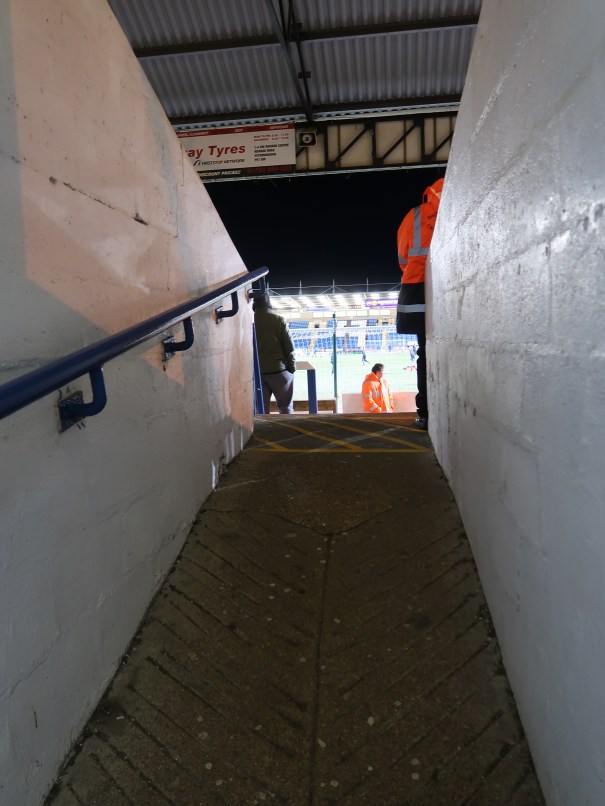 It may sound academic to state, that little plastic seats were installed to isolate the fans, to take the sometimes uncontrollable group dynamic out of crowds. But it is certainly what happens. There may be grounds, where the game generates oohs and ahhs in the stands. Some, where they even join into some chanting. But most of the time, it is generally so quiet, that you clearly can hear the moaner 20 seats away, who will never stop yelling out his complaints. But you hardly ever get this light mood of comraderie. And with safe standing, you still have a fixed place. You cannot move around and join up.
 Even though conditions get increasingly difficult, the match is not bad. The pace and aggressiveness of Posh striker Jack Marriatt causes the Walsall defence all sorts of problems. And shortly before the interval, Peterborough get the equalizer, they deserve. It raises the spirits even more just in time for halftime.
 Arguably, a warm concourse would have been nice. But there is something fascinating about queuing up in the floodlit snow behind the stand for a cup of hot bovril. And it does help keep warm.
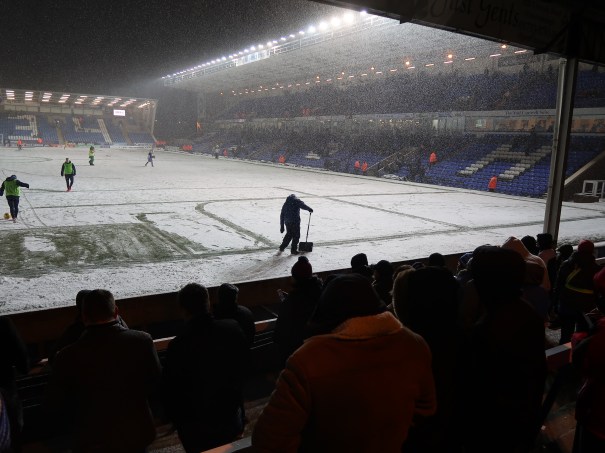 During halftime, the groundsmen are busy shovelling snow off the lines. The two most eager set about clearing a penalty area each – but only about the third closest to the main stand is cleared before the players reappear.
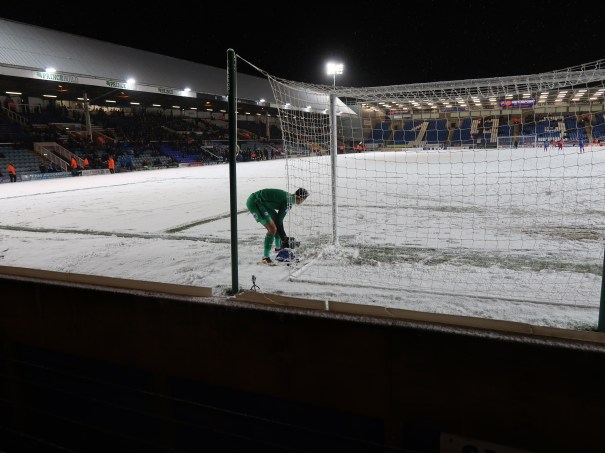 Another first, is Peterborough keeper Bond bringing a hot water bottle, having to warm his fingers on it every 10 minutes. Peterborough takes the lead some 10 minutes into the second half – and with the need to keep warm at the same time becoming more and more urgent, the singing and shouting picks up. So does the snow after a brief pause. It is difficult to see the goal down the other end, and the keeper Bond scrapes marks in the snow to help him in his positioning.
 With less than 10 minutes to go, the referee stops the game. It will not be continued till the lines have been cleared of snow. The groundsmen slowly start to clear the lines, when Peterborough – and former Newcastle – defensive stalwart Steven Taylor grabs a broom from a groundsman. Half running, he ploughs his way through the snow covering the lines of the penalty box. In doing so, he overtakes a groundsman with a snow shovel, which he takes out of his hand.
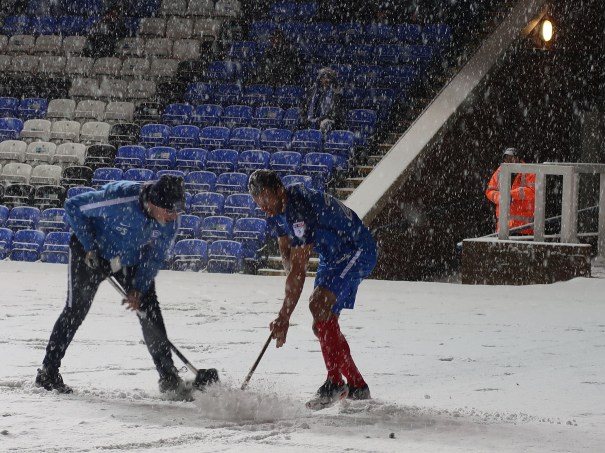 The fans cheer loudly. How many premier league players would put in a shift like that? He is also one of a handful players only wearing sleeveless shirt. Suddenly, it is Steven Taylor’s name being chanted.
 In the final ten minutes, Peterborough have to withstand severe pressure from Walsall. Taylor flings himself down into the snow to block a shot. The ball bounces in front of his head as he is lying in the snow. So he throws himself forward through the snow to head it away, still lying down. The crowd is ecstatic. If he didn’t have cult status among Peterborough fans before, he has now.
 There are 8 minutes of added time, before Peterborough can breath a sigh of relief. And Steven Taylor is the first to run to the crowd with clenched fists, screaming triumphantly. He has earned it.
 It is kind of surreal to walk from the ground. There are not many supporters walking back towards the town centre. And in the snow, with no cars, it is completely silent. Not the usual huzzle and buzzle on leaving.
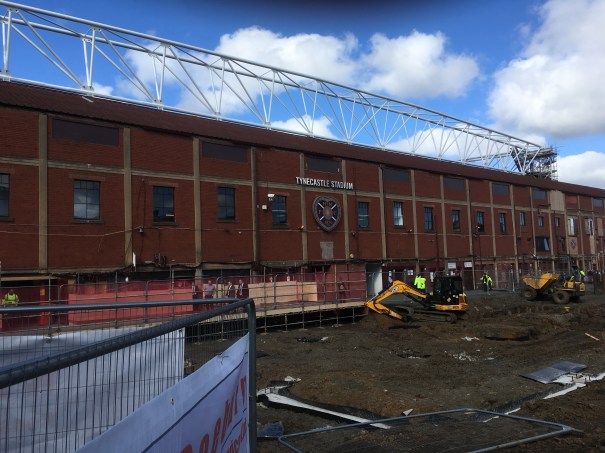
 The third and final day of Dynamo Birkerod´s trip of Scottish football grounds is, arguably, the big one. It will probably be the title-decider. And it will be our last chance ever to get a look at Archibald Leitch’s main stand – in a month from now, bulldozers will move in and tear it down. And – it is a category A match.
 To prevent trouble, the police restrict ticket sales for category A matches. Only fans with a documented buying history as fans of the club are allowed to buy tickets – and only one ticket each. I had established a buying history a month previously – but that was not enough for me to apply for a ticket.
 Not only that. He has also arranged that Hearts marketing officer Dylan will show us around the new memorial garden and museum at Tynecastle, which is otherwise closed on matchdays. I am particularly delighted with that, as I am working on an article about football memorial gardens. Depending on where you draw the line between a memorial garden and memorial monument, there are somewhere between 20 and 30 at British football grounds now.
 Still, Hearts got off to a flying start to the new league season in 1914 – beating Celtic 2-0 in the opening fixture and winning the first eight matches, 19 out of the opening 21. But as rugby and cricket players (amateurs) suspended their leagues to join the army, criticism of the professional footballers carrying on with their trade increased. And at the end of November 1914, almost the entire Hearts team signed up for the army. They were joined by a number of players from Hibernian, Raith Rovers and Dunfermeline.
 Hearts suffered their first two defeats of the season, when the team had been out all night for military training and had to get straight on the train for matches the next morning without sleeping. Hearts won only 8 out of the last 17 matches after signing up, with Celtic overtaking them for the title at the end of the season – with none of the prolific Glasgow players having signed up.
 Seven of the Hearts players lost their lives in the war. Several supporters – who signed up with the players for McRae’s battalion – also lost their lives. Attendances dropped – and so the club revenue. A new entertainment tax to finance the war effort added to Hearts’ financial woes.The cost of the new stand, however, went the other way. Completed in October 1915, the total cost was double the original estimate, £12.178. Along the way, the relations between the club and Archie had soured, and on the plaque mounted on the stand to commemorate the erection, all board members were named, but not the architect – Archie – as was customary.
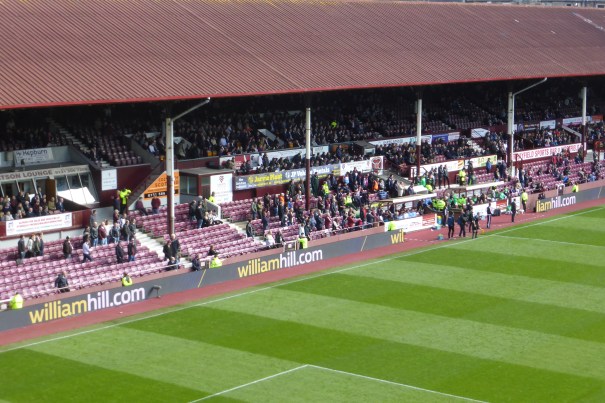 So in the light of history, today’s match could tie up a few loose ends. As well as bidding Archie’s stand goodbye at a time, when Hearts have just been saved from deep financial troubles, Hearts have the chance to dent Celtic’s unbeaten march towards the title. Celtic, who without contributing to the war effort a hundred years ago, benefited from Hearts’ sacrifice and took the title out of Hearts’ grasp.


 We make our way around the Gorgie Road end to the Wheatfield Street entrance, and meet Dylan in the club shop. He shows us a playing kit designed two years ago to thank the 8000 supporters who gave more than £120 to save the club. So far, the foundation has contributed five million pounds! Amazing. Obviously, it is a shirt, I have to buy.
 From the shop, we walk around to the Memorial Garden – “Forever in our Hearts”, opened in 2015. It is very different to most of the memorial gardens, I have visited so far. It is not intended to be a place, where you can scatter the ashes or bury the urn of your relatives, although Dylan guess that there are fans who sneak in to scatter the ashes of relatives among the plants.
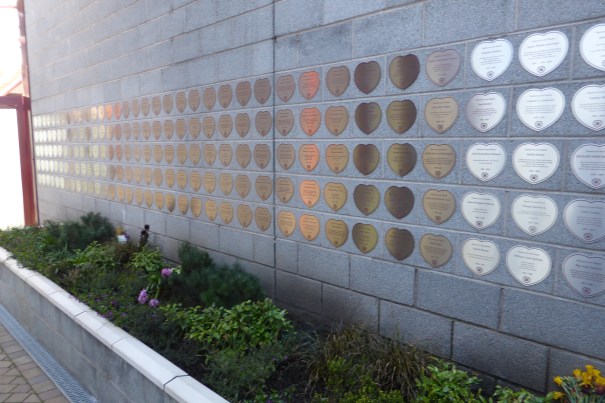 That is one major difference. Another major difference is that it is strictly designed. Other gardens are a jumble of individual expressions of identity and grief – but here, the only way of expression is to put a text within a metal Heart plaque. There is space for 8000 Hearts – the same number as the number of names on the shirt. At the price of £215.
 It is not only supporters featured here, though. There are also deceased former players, mixed among the fans in no particular order. They are important, but not more important than the fans. As a sign puts it: “The fans – the one true constant. Thank you”. It is no coincidence that the statue erected by the garden is an anonymous representative of McCrae’s battalion which had players as well as supporters signing up.
 Although all individual statements have to be expressed within the same narrow frame of the steel heart, there is still room for individuals to stand out. Dylan points out his favourite plaque: “In memory of Dave. He loved the pub. He loved Heart of Midlothian. He tolerated his family”.
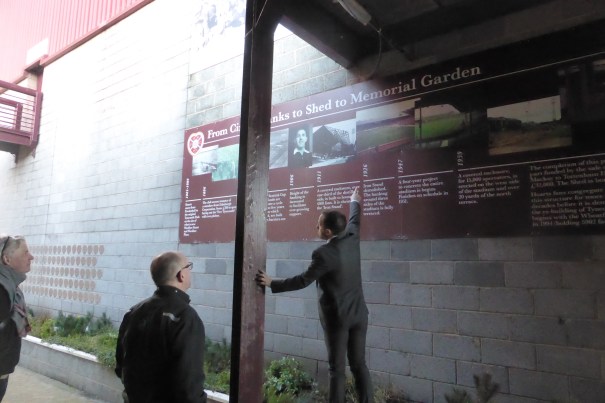 Jes asks Kelly about the values of Hearts – compared to what we saw at Rangers the other day. He doesn’t want to be drawn into discussing Rangers, but focuses on the community work and sponsorship policy of Hearts – they have “Save the children” as shirt sponsors. Of course, you could argue that Hearts are the protestant club of Edinburgh, just as Rangers are in Glasgow, both of them with catholic rivals. And at least some years ago, the “Billy Boys” song could be heard from sections of the Hearts crowd. But the religious element seems to have disappeared from the Edinburgh rivalry, and Hearts have worked deliberately on stamping out that element of the crowd.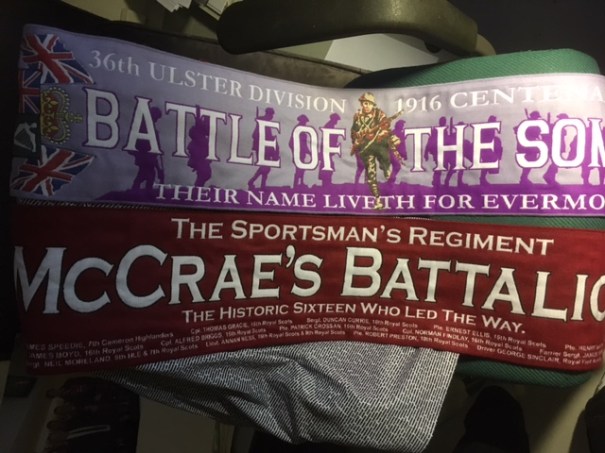
 You could argue that it is strange that the memorial garden of a club, emphazising the importance of the fans so much, should be so strictly regulated. All messages put on the standardized plaques. The space is carefully designed around a bronze and steel sculpture of the club crest wit a football in the centre – that brings you could luck, if you touch it. It is surrounded by three steel benches.

 “Do not ask where Hearts are playing and then look at me askance. If it’s football that you are wanting, you must come with us to France”.


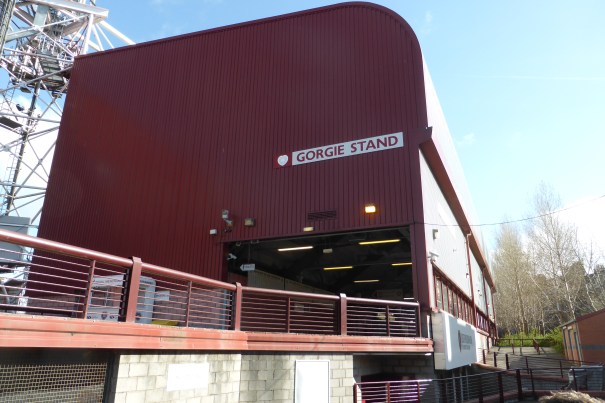 From the garden, we walk to the other end of the ground to the Gorgie Stand to have a look around the museum. David, the assistant curator, is in to greet us. It is a really nice little museum, set up last year in a room originally build as club shop on the initiative of Ann Budge.
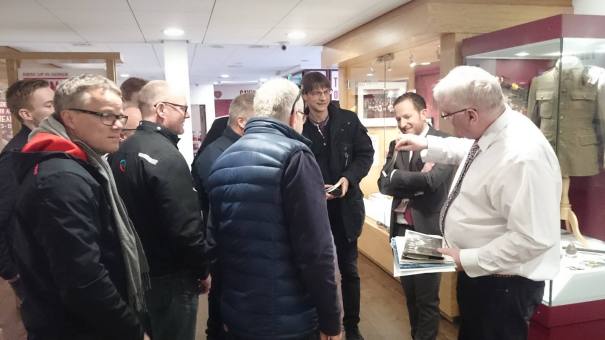 Ann Budge formed a consortium to buy the shareholding majority of the club during the 2014 turmoil, to allow the fans’ Foundation of Hearts time to raise the money to take over the ownership officially. When she one day saw the club archive and the objects gathered there, she wanted a museum established to show it to the fans. And it is really made for the fans. For one thing, entrance is free of charge, whereas you have to pay around £ 10 in other club museums, as they mainly target footballing tourists who are prepared to spend to get the entire package.
 The Hearts museum is – just like the memorial garden – atypical as a football club museum. They often tend to be designed as branding platforms, reflecting just how much success the club has had, often as part of an argument for being the best, the greatest, the most popular or the first to achieve something. And this argument is accompanied with a hall of fame element. They seem to be designed primarily to win over neutral visitors to become supporters through their claim to greatness.
 But, of course, there is also a special place for Hearts’ greatest team that won the title in 1958 with a record number of points, goals scored and goal difference. 132 goals in 34 matches! Impressive. But what intrigues me most in the museum are the souvenirs taken back from Denmark, when Hearts visited Copenhagen in 1912 and 1914. A china polar bear, and a swastika needle from the Carlsberg breweries.


 It is fairly crowded in the tiny tunnel – and noisy. Electronic music is blasting out from somewhere. A camera man from Sky Sports block the tunnel – he is waiting for the Celtic players to arrive – and we have to stand behind him and wait for them to pass. I can see on Dylan that he didn’t plan this – and wants us to get out of there as quickly as possible. When apparently all the Celtic players have passed, he tells us to follow him as quickly as we can out of there.
 As we gather outside the main stand, everybody seems a bit starstruck and realize that this was a bit extraordinary. Jonas, one of Ib’s son, is excited that he shook the hand of Kolo Toure, as he arrived as one of the last Celtic players.
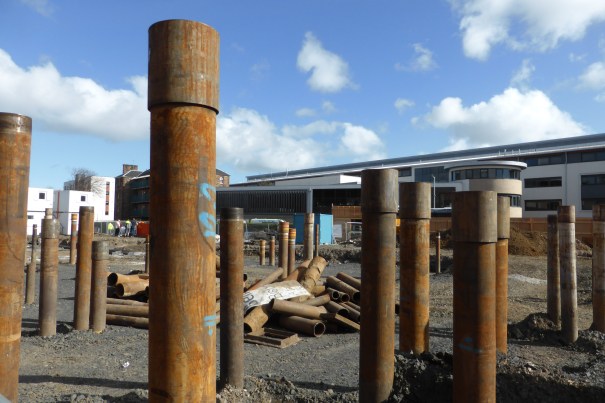 Dylan points out where the new stand will be. They will build it in stages, so it will be ready for matches already by September. And then the rest with offices etc. will be completed afterwards. I have a long last look at Archie’s stand …
 We thank for an amazing tour, and take the short walk to the pub “The Athletic Arms”, called “the Diggers” as it is situated between to cemeteries. Most of us have a pint and a pie – and they are really good. It is a really great place. The atmosphere is good, there are plenty of old football photos on the wall – and the television show the Sky Sports build-up to the match, so we get a deja-vu of the Celtic players arriving in the tunnel.


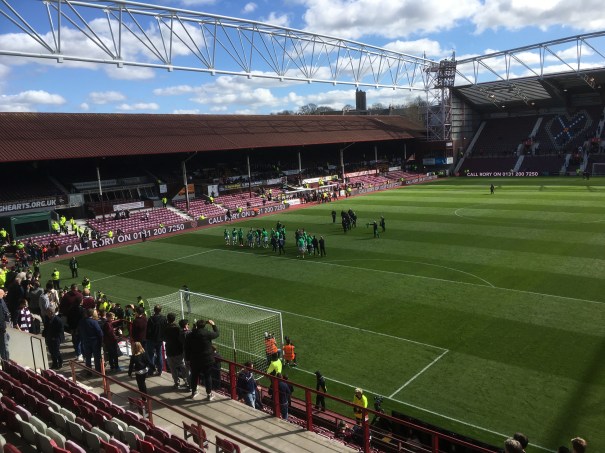
 Inside the ground, I send long looks to Archie’s stand. It may look a bit dated between the two larger cantilevered stands, and it is somehow dwarfed by the big white steel gantry in place for its successor.
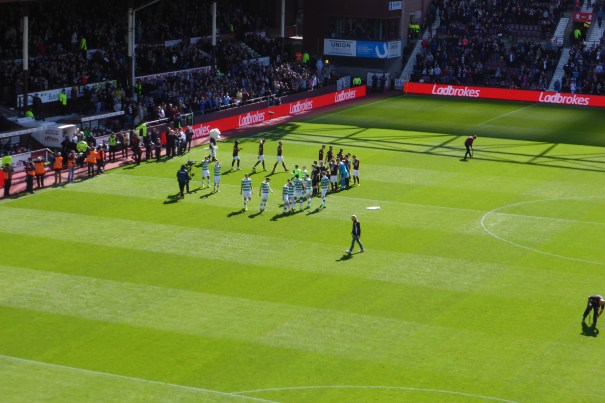 The players enter the field to the tune of the 1950’s “Glorious Hearts” recording. It goes well with Archie’s stand. I wonder if they will – like Glasgow Rangers – persevere with it, when the new stand takes over, or they will go all ‘modern’ like Glasgow Rangers and play “Simply the best”.
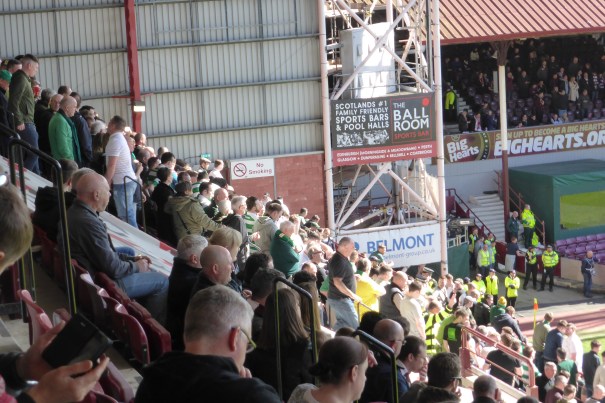 Of course, Celtic have a massive turnout for the match – and they are in pretty good voice, although, I must admit, I had expected a bit more from them. They are not as vocal as many other travelling supports, even though they are on the verge of winning the title.
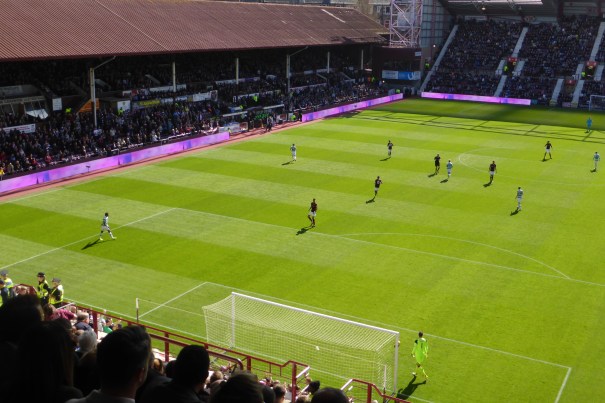 The Hearts crowd, though, are in good voice, as Hearts make a good, highpressing start to the game, unsettling Celtic. Ooohhhs and ahhrsss accompany tackles and passes – and you really get the match under your skin. A stark contrast to the ultra-element at Ibrox the previous day. This is what British football is about. I love every second of it.
 Whereas I was way off the mark with my 4-0 prediction for Rangers the previous day, I am proved right. Just after the halfway point of the first half, two Sinclair goals within the space of 4 minutes, put Celtic firmly in the driving seat.
 Just before the second goal, Celtic’s Swedish full back Mikael Lustig had gone down injured, calling for a foul and probably a card to a Hearts player. But as Sinclair races through to score, he jumps up and runs over to celebrate. The Hearts fans are angered by this miraculous resurrection. When Lustig goes to the touchline for to retrive the ball from the crowd for a throw-in – he gets it full force in the groin. As he turns and squares up towards the fans, they hurl abuse at him. On of them seems to spit at him, as he shouts him right in the face. But he just manages to keep his cool.


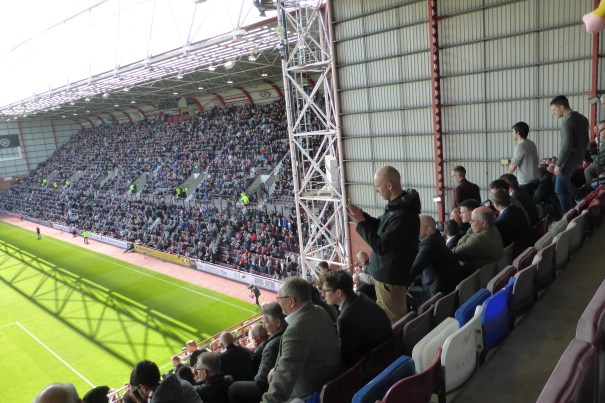 The atmosphere has lost the incredible edge of the opening 23 minutes. Nobody really believes that there is way back into this for Hearts. But still, the crowd tries to get behind the team at the start of the second half. But after 10 minutes, Celtic add a third goal. And that is it. Just like at Dundee on the Friday, the third goal sparks an exodus.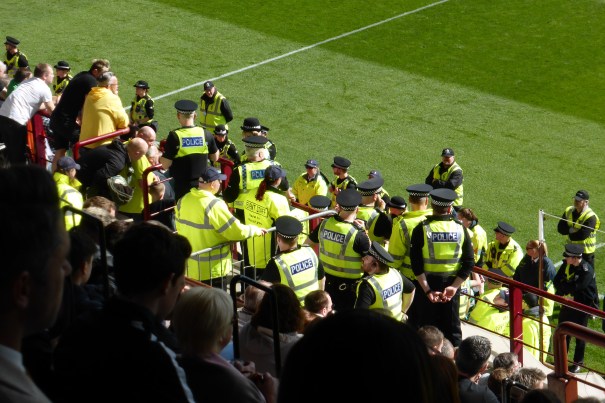
 At the end of the match, the Celtic players run over to celebrate with their supporters. The players also seem a bit subdued in their celebrations. All the Hearts supporters have left – we are almost all alone with the Celtic supporters, players – and the security.
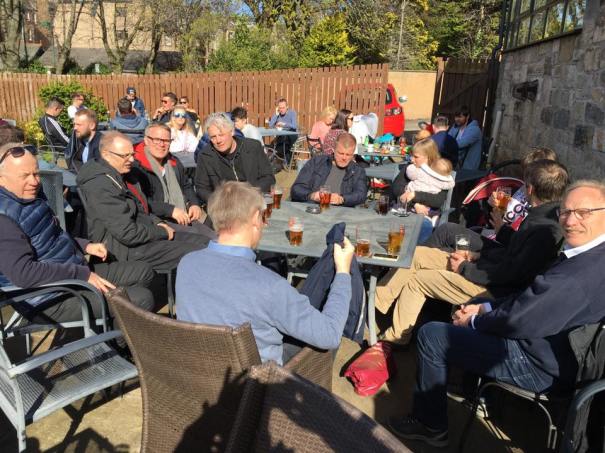
 By the time we leave the ground, there is no crowd outside. We head for the Royal Ettrick Hotel’s Beer garden to meet up with Siobhan and Chris, and their daughter Daisy. The sun is shining, the beer is good, just like the company. After a pretty tight schedule for three days with a lot of tense build-up, it is almost meditative to sit here and talk in the sun.
 Back to the city centre, where we have dinner at The Devil’s Advocate, next to the filming for the Avengers: Infinity War. Afterwards, we head to the 500 year old White Hart pub. I ask each of my fellow travellers if they have taken one particular Scottish team to Heart after seeing four of the top six clubs in action over three matches.

 Football, after all, comes from the heart. It is about identity and values. Of course, winning is nice, and loosing is painful. But despite the ever growing media focus on success, and television fans switching their loyalties as quickly as switching channels, there is something beautiful about the material culture of a club seducing a group of grown-up men actually being there and sensing it – despite the club loosing 5-0 at home.
 We are still on a high after Aberdeen’s 7 goals at Dens Park the previous night. And now our Dynamo Birkerod team is completed with the late arrival of Ib and his two sons last night. We are a full team of 11 now.
 In fact, we are so high, that rather than taking a cab from Glasgow Queen Street Station to Hampden Park, the first stop of the day, we decide to go by bus to get a closer look at the city. Finding the bus stop, however, proves a bit of a challenge, as my smartphone sends me first in one and then the opposite direction. We ask a policeman for directions. He tells us to go to the gallery of modern art – “with a statue with a cone on the top of the head”. Nevertheless, we are taken by surprise when we discover, that it is actually a 19th century equastrian statue of the Duke of Wellington with a modern, orange traffic cone on top of his head.
 Our wandering around means that we are a little late on arrival at Hampden Park, not only the National Scottish football stadium, but also the home of the Scottish Football Museum. I tell the guy at the ticket office that we are a famous Danish football team, following in the footsteps of Archibald Leitch, the famous Scottish football architect, making a stop at Hampden on our way to Ibrox. He is a Rangers fan himself.
 At first, he suggests that we should go on the stadium tour, but on second thoughts he advises us not to do so. If we want a drink before the match, we have to leave Hampden in just over an hour. So we settle for tickets for the football museum. But a few moments after entering the museum, a staff member comes across to us. He has heard of our quest, and offers us a look inside the ground, now that we can’t go on the tour.
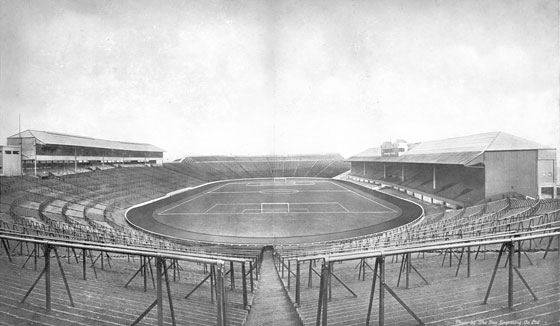
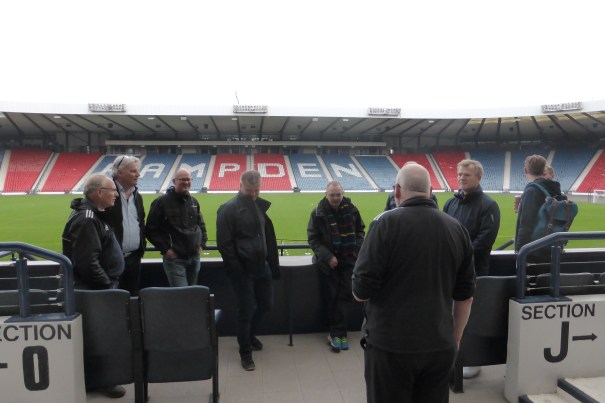 We are taken to the VIP box where trophies are presented. It is a really beautiful, harmonic ground. Yet, I can’t help comparing with the photos I have seen of the ‘old’ Hampden. Hampden Park used to be the biggest football ground in the world, reaching a 150.000 capacity. Almost all of them standing on huge terraces. A really amazing, awe-inspiring sight.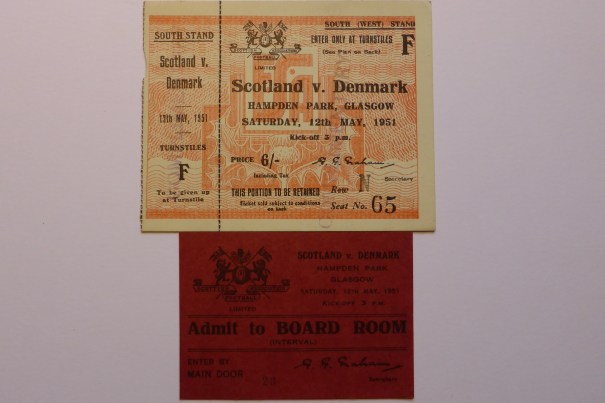
 The ‘new’ Hampden just looks nice, seen from the VIP box. It is not as big as Celtic park or Ibrox. Standing inside the ground, it is hard to believe that it can hold 50.000. It looks much bigger from the outside, partly because of the many crush barriers sectioning the stairs around the ground for crowd control. Probably designed in the light of a catastrophe at Ibrox back in 1971. As people left the ground by the end of the match, somebody fell over at the foot of long stairway. The push of people leaving the ground and pouring down the stairway was so strong that 66 people were killed and more than 200 injured – a story that is being told inside the museum. Around the new Hampden, the efforts to control the flow of the crowd are quite noticeable.
 The museum tells another, slightly different, story of havoc and crowd control – about the worst ever football riot in 1909. The replay of the Scottish cup final between Celtic and Rangers ended in a second draw, paving the way for yet another moneyspinning replay. Even before the match, rumours were rife that the clubs had fixed the match to go to a replay. Fans of both teams reacted to the second draw by going rampant, not just tearing down the goals, but also burning down the turnstile block. No replay was played and the cup and medals were withheld that year.

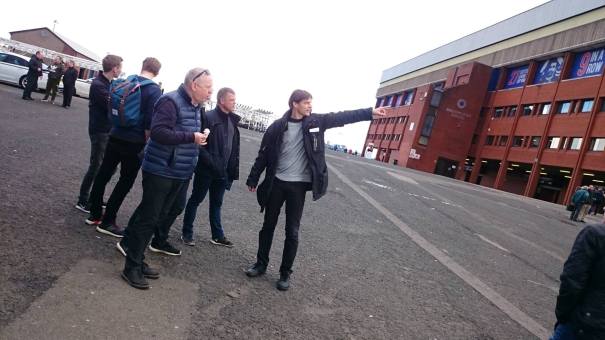
 We leave for Ibrox just before noon with 3 hours to kick-off. It is only a 20 minute taxi ride away. Archibald Leitch’s main stand at Ibrox is in stark contrast to the main stand at Dens Park. He wanted Ibrox to be his masterpiece. For two reasons. He was a Glasgow Rangers supporter, and his first ever attempt at constructing a football ground at Ibrox had ended in catastrophe.
 Archibald Leitch – who until then had worked on constructing factories – had for his first footballing commission erected wooden terraces at Ibrox in 1899. During an international between Scotland and England in 1902, however, the construction gave in to the weight of the crowd. 26 people were killed, and more than 500 injured, as fans fell through the construction onto the steel columns and concrete underneath. There was a court case afterwards, where Archie explained the accident by pointing out, that yellow rather than the prescribed red pine had been used for the construction.
 Leitch pleaded with Rangers to give him another chance, even while the court case was going on. The fact, that they were persuaded, may also have had an influence on the outcome of the case. And it was from this experience, that Archibald developed the solid terrace banking with regular steps, steel barriers, designated aisles and account of sight lines.
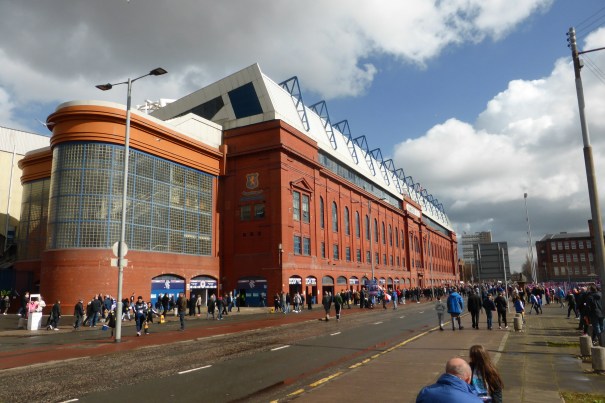
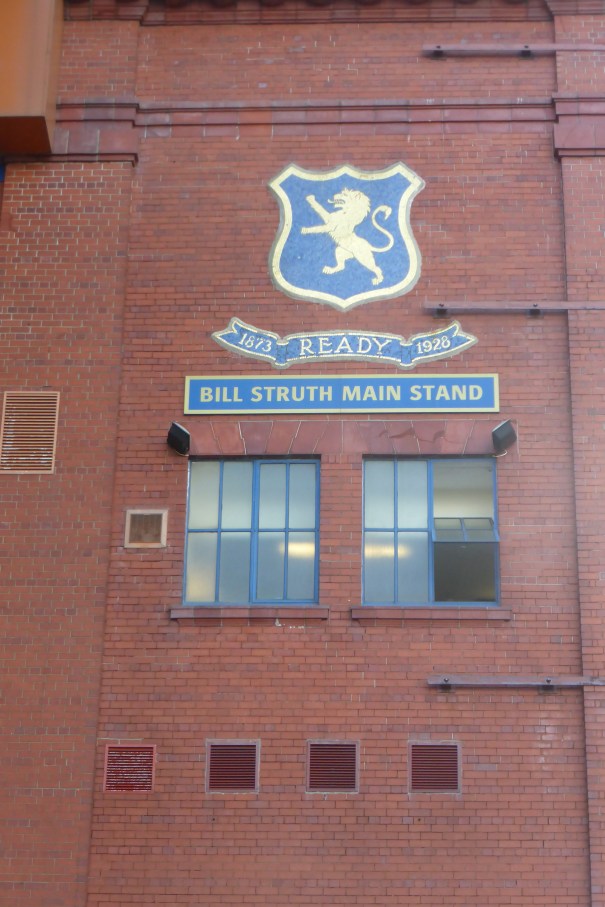 And then in 1926-8, he was invited back to design a grand stand that could raise Ibrox to be the number one ground in Scotland. He had just completed the impressive red brick grand stand at Villa Park, and it was probably this that served as an inspiration. And it really is an impressive sight.
 Underneath huge arched windows, there are symmetrical, arched openings all along the front. Huge mosaic crests adorn the sides of the stand. The main entrance resembles the entrance of a hotel, very different to the utilitarian look of Dens Park.
 The unfortunate thing about going here on a match day is that we can’t get on a guided tour. And – we haven’t been able to get tickets for the grand stand, so we don’t get to have a look inside. I just can’t wait to get back for such a tour to see the marble floored entrance hall with art deco lights, the polished oak panelling in the blue room – and the huge concourse enlightened by daylight from the huge windows.
 On the corner of the grand stand, there is a statue of former Rangers player John Greig. He was voted best ever Rangers player back in 1999, and the statue was erected two years later. It forms part of a memorial for the victims of the Ibrox disaster in 1971. Whereas the rest of the footballing world started to rebuild stadiums in the aftermath of Hillsborough in 1989, Rangers had by then rebuilt the other three stands of Ibrox as a consequense of the 1971 disaster. Moving from standing terraces to seated stands.
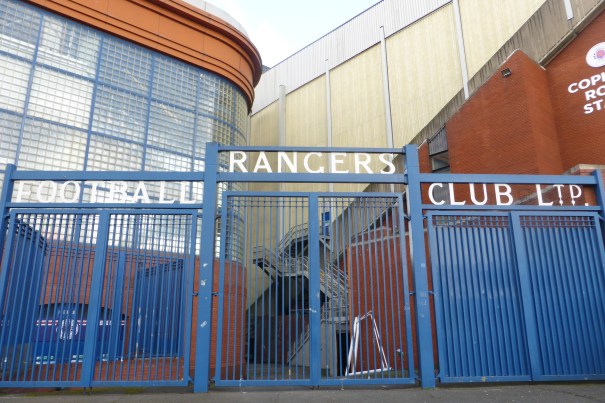 When Aston Villa made their move towards an all-seater stadium in 2000, they demolished their Trinity stand by Archie, even though it was listed, to make room for more seats. Rangers, fortunately, chose to preserve their listed stand, and at a huge cost make an extension on top of it. So not only does the Leitch stand have an additional deck on the top, it is sandwiched by stairway towers in steelframed glass, taking supporters to the new deck. The new towers, though, are shielded by Archie’s steel gates, proclaiming that this is the home of Rangers Football Club Ltd.
 While I am absorbed in looking at the stand, the others have a burger outside the ground and then go looking for a drink. They call me to say that they have set up camp in a Rangers club a few hundred yards away and are waiting for me in the beer garden. It is called the “Wee Rangers Club”, and it doesn’t really look much from the outside. There is a £3 entrance fee, and I head straight for the garden to catch up with the others. With the sun shining, it seems a lovely place to tank up for the match – but out of nowhere, a shower makes us go inside to have a look around.
  The main room is fairly dark. Blue Rangers curtains to match the blue Rangers wall paper ensure that fans can follow the action of the Liverpool derby on big TV screens. There is, though, no sound on the telly. Instead a music box is playing pipes and drum militant music, with the fans frequently joining in, singing and stamping. It all has a distinct militant edge. Among the tunes, I recognize the “Billy Boys” song, which was banned by law from Scottish football grounds in 2011, due to its sectarian content.
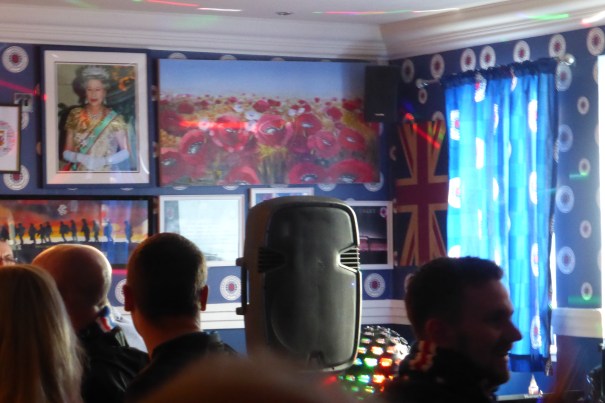 At the bar, there are several portraits of Queen Elizabeth on the wall, red poppies, Union Jacks and references to the Ulster division and WW1. I am used to seeing fans gathering at pubs before matches, singing songs of their hatred to rival clubs. But somehow the attachment of the songs to historical, religious and political events and figures make this quite scary. The rivalry between the Protestant, unionist Rangers and the Catholic, separatist Celtic is arguably among the most sectarian footballing rivalries in the world. And although the two clubs don’t come head to head here today, it looms over everything.
 Or maybe it is just me being a historian, paying too much attention to these historical dimensions to it all. One of my teammates, Jon, questions whether the fans actually put any real content in all these unionist expressions. Maybe they have just been brought up with this as the natural way to get into the mood for a match and don’t really think of the content.
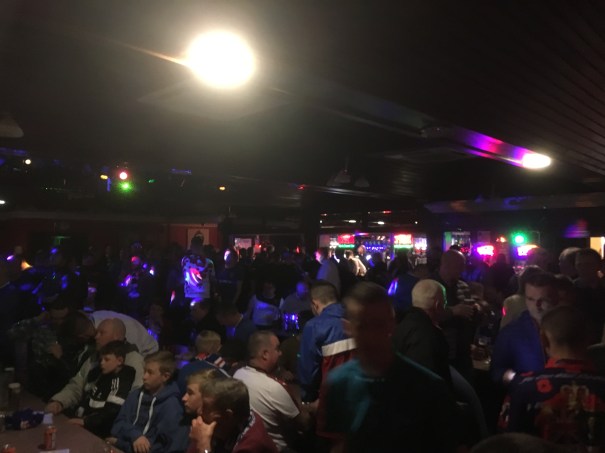 He is certainly right about the part of kids being brought up on this. Tam suggests that we go and have a look down in the basement, where he says it is all songs about hatred to rivals Celtic. And down there in the darkness, there are quite a few kids at the age of 10-12, listening to the militant battle songs. Maybe the kids are only allowed in, because the match today is against Motherwell. When I afterwards check the facebook page of the Wee club, they have posts for the season’s Old Firm derby days stressing that it is strictly over 18’s only – and that the resident DJ will be playing “all our favourite tunes” with “a cultural evening afterwards”. I wonder what kind of cultural event that is.
 Perhaps, I get an indication on a board on the stairwell to the basement. It proclaims that only those visitors who follow the custom of paying tribute to the queen are welcome here.
 As we leave for the ground, I wonder whether we have just happened to land in an isolated sectarian stronghold, giving a distorted view of the true Rangers culture. That there is more to it than the Wee club, however, is reflected in the many stalls around the ground, selling flags and scarves. They all reflect the same sectarianism. “No surrender”, “We stand for our flag, we kneel for our fallen”, “Rule Britannia”, “God save our Queen”.
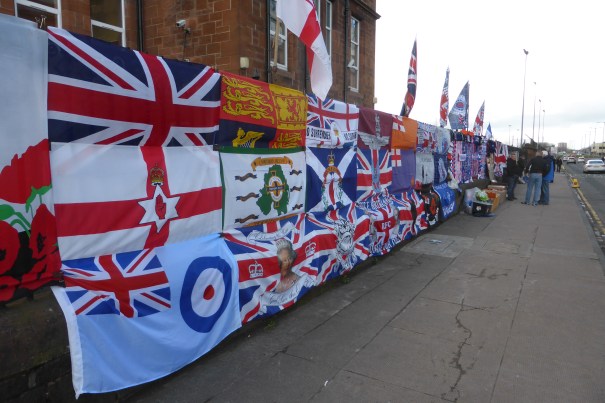 The union jack colours of Rangers are mixed with the orange of William of Orange, who defeated the catholic army of Ireland in the battle of the Boyne in 1690. The messages on the banners are open declarations of Ulster loaylism. “William of Orange”, “King Billy on the Wall”, “We are the People”, “No surrender”.
 Special football scarves have over the past couple of years been made to commemorate the fallen of WW1, featuring the poppy, “lest we forget” and last year “Battle of the Somme 1916” – the most bloody day in the history of the British army. At Rangers, the Battle of the Somme scarf is focused on the Ulster division. As I work in a WW1 museum and I am interested in the use of history, I buy one of those out of purely academic interest – and immediately hide it in my pocket, as I don’t want to be seen with it.
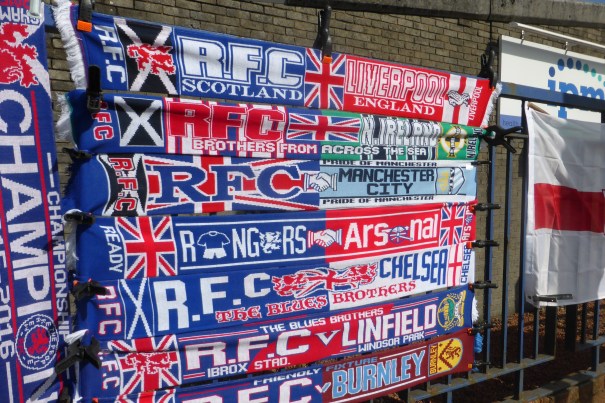 In one of the stalls, “brothers” scarves connecting Rangers with a string of English clubs are for sale. Liverpool, Chelsea, Arsenal and Manchester City. I am relieved that there is no Manchester United scarf. But then I do remember, going to United matches in the 80’s, when sporadic chants of “Celtic” from the Stretford End would be answered by chants of “Rangers” from other parts of the stand. There were also the odd half Celtic or Rangers, half United ski hat. I never really understood it.
 However, it seemed to be that the majority of United supporters favoured Celtic. Some claim that United have a strong catholic element, but perhaps it also played it’s part that Rangers back in 1974 brought 30.000 fans for a pre-season friendly, taking the United Red Army completely by surprise. But judging from United forums, most people in Manchester have forgottten about the link to the Glasgow rivalry. I am, though, at bit surprised that Rangers should have a brotherhood with Liverpool. I would have thought that they would distaste the use of “You’ll never walk alone” – with Celtic and Liverpool sharing the same pre-match anthem.


 After about three minutes, Jens and I look at each other in despair – Motherwell take the lead from a corner. And from then on, they seem to be in control and pose most of the danger, as Rangers just seem to be frustrated about things not going according to plan. You would have expected the away support to go wild. In one of my favourite football books “Saturday 3 p.m.”, Daniel Gray writes about the 50 eternal delights of football. One of them is to watch an away-end erupt in celebration of a goal. But he stresses that it has to be a packed away end. A few hundred scattered away fans only “resemble survivors of a shipwreck” waving for attention. This is what the Motherwell fans look like – in stark contrast to the wildly celebrating Aberdeen fans the previous night.
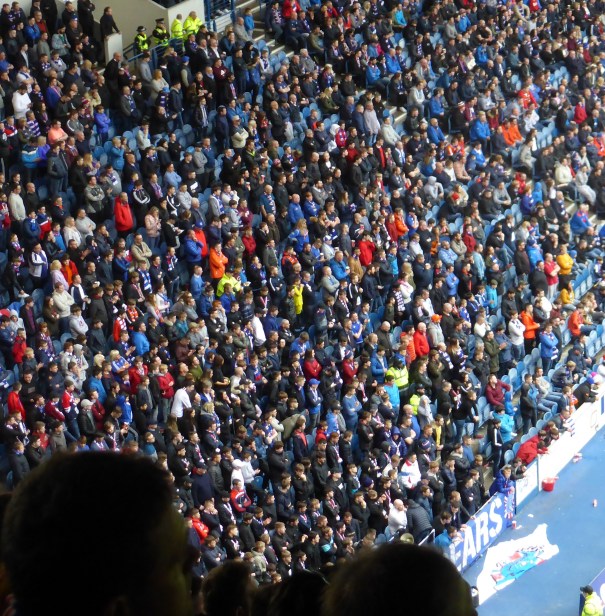 Adding to this overriding sense of frustration inside Ibrox, is the small Rangers “ultra” element in the corner below our seats. “Union Bears” a banner proclaim. A guy is standing on a platform with a megaphone, his back turned to the game. Time and time again he tries to get a chant going to a tune you in Denmark associate with drunks, who are too pissed to be able to express actual words. There is also a drum to accompany it. It is completely out of sync with what is going on on the pitch. And it somehow punctures the customary passionate oooohhhhs and aaaarhhhss, when tackles fly in that is the trademark of British fan culture. There is no help for the team in this. The chanting doesn’t influence the match. It doesn’t kick the players on. It just gives an annoying undercurrent, a feeling that some drunken fans are ego-tripping their way through it.
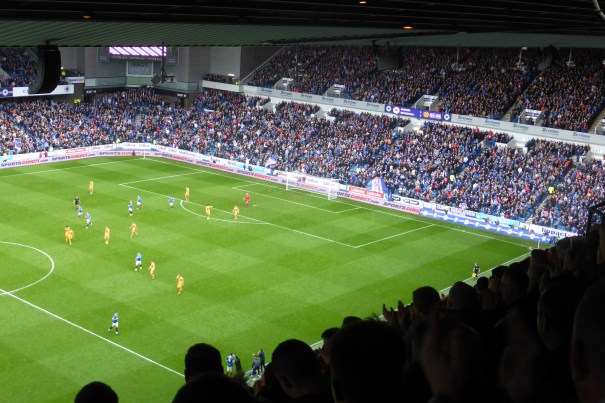 This summer, my son and I went to see F.C. Copenhagen play. We were both annoyed by this fan culture, so different from the passionate, traditional British way of living every tackle, shot and pass of the game. So it seems ironic that Rangers of all teams, whose supporters wrap themselves up in Union Jack and Unionism, should have a – albeit very small – continental ultra element.
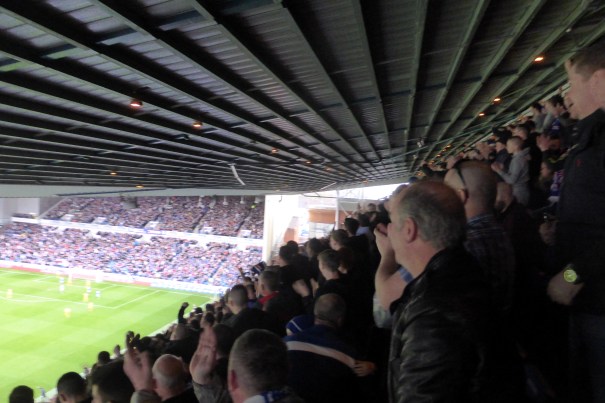 In the second half, Rangers do get an equalizer, the game opens up with chances at both ends (by far the best ones to Motherwell, by the way), and on a couple of occasions the ultra element is drowned out by the entire stadium roaring and chanting.


 I will go back to Ibrox for a guided stadium tour one day – and to watch a match from Archie’s stand. Hopefully before then, I can get into contact with some Rangers fans with a less sectarian stance. Normally, when I visit a new football ground and go in the home section, I develop a warm sympathy for the club. Even though the Rangers fans’ at the Wee club were nice towards us, I don’t go away with a feeling of sympathy this time. Perhaps too much sectarianism sticks to the scarf, hidden in my pocket.
 As the purpose of my veteran football club, Dynamo Birkerod, is to provide sports and cultural activities in the Anglo-Saxon football and gentleman tradition to the benefit of the members’ physical and intellectual well-being, I had decided to organize a three day trip to Scotland to see three classical football grounds with stands made by the iconic stadium designer from the early 20th century, Archibald Leitch.
 Back in the 80’s, almost every other football ground in Britain seemed to get it’s distinctive features from a stand designed by the entrepreneurial Scotsman in the first two or three decades of the century. But after the Taylor report in 1990, almost all British stadiums have been relocated or rebuilt. There is less than a dozen grounds with Archibald Leitch stands left now. Two years ago, I took Dynamo to one of them, Goodison Park, Everton. This time around, we are going for three. Dens Park in Dundee, Ibrox in Glasgow, and Tynecastle in Edinburgh. And just in the nick of time, as the Archibald Leitch stand at Tynecastle is about to be bulldozed away in a month from now.
 Alas, Ib – our club journalist – cannot make the first match due to work commitments, but will join us with his two sons after the match. So we are only eight Dynamo members getting together at the airport at noon Friday. We have a pretty tight schedule to get to Dundee in time. From the scheduled landing time in Edinburgh, we have exactly an hour and a half to get to our hotel in the city center, drop our luggage, get to the station and pick up the tickets from the ticket-collect-machine and catch our train for Dundee.
 We get to Dundee about half an hour late. There is still about two hours to kick-off, so we don’t panic but decide to walk to the ground, which should be just a 30 minutes’ walk away. The walk, however, is mainly uphill. We meet two other men of the same age as us (that is 50’ish or 60’ish). They have travelled from Middlesbrough to see the match. One of them had been to about a thousand football grounds. After doing the league grounds, he was now doing the non-league grounds as well. In England and Scotland. In fact, he even knows of my Danish club, BK Frem. I am deeply impressed, but he claims that he is just as impressed to meet a Dane, who knows about Archibald Leitch.
 We finally get to the ground, shake hands with the Middlesbrough lads and wish each other a good game. By now, there is a desperate craving for fish ‘n chips in our group, but I insist on collecting our tickets before. I am, however, more business-like than usual, and don’t really get a look around to see what the souvenir shop has to offer.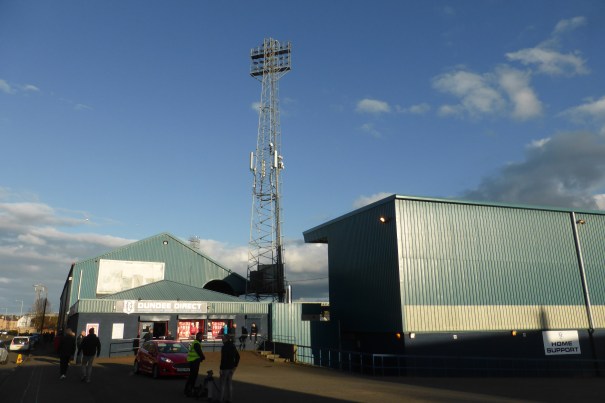
 The staff are not that efficient – or, perhaps, used to customers who are in a hurry. It takes quite some time for them to get 8 trays ready for us. With so much effort put into it, I would have expected better chips. They are rather pale and soft. Tam, who is in the habit of having a beer at halftime when we are playing ourselves, decide to go to an off-license store to get some beer to make the chips go down. He comes back with an eight-pack.
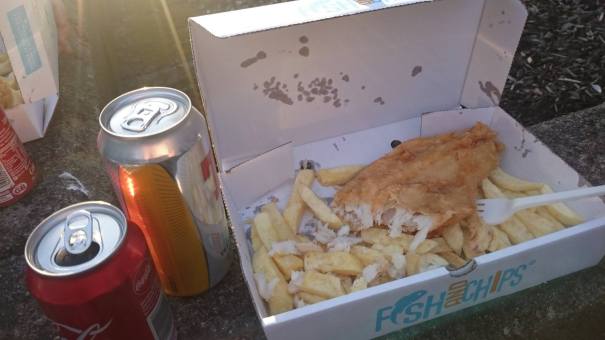 By now, I am getting a bit nervous. Apart from the Archibald Leitch stand, what makes Dundee a special place to watch football, is the fact that the distance between Dundee F.C.s Dens Park and Dundee United’s Tannardice is the shortest distance between two rival football grounds in Britain – if not in the world. Just over a hundred yards. A good goalkeeper would be able to kick the ball from the corner of one ground to the corner of the other. No wonder that the away team sometimes prefer to change at home in the Dundee derbies. To have two grounds almost within touching distance is really something to dwell on and take in.
 My nervousness increases, as some of the lads start to discuss whether there is time to visit a pub close by. Jes, our literature man, spots my nervousness and sends me off, telling me I have to do my anthropological field work.
 As almost all the fans, I have seen heading for the match, had walked down Hindmarsh Avenue, I decide to follow in their steps. I should have checked my google map, as another choice would have enabled me to walk along with Tannardice, Dundee United’s ground. Now, I end up right in the middle of no-mans land between the two grounds. Roughly the distance between the trenches in WW1.

 The main stand at Dens Park is captivating. Built just after WW1 on a tight budget, it is one of Archie’s more utilitarian stands. Everything that could be done to save money, was done. The cheapest materials, the front terracing sunk under pitch level to accommodate more spectators and at the same time keep the height of the stand to a cost-saving minimum. And whereas modern grounds usually are designed as a harmonic unit, the main stand is designed to follow the curve of the road. Where football clubs today would buy surrounding lands or roads, this ground is fitted into the existing structure. On top of these efforts to keep expenses on the new stand down, the predecessing wooden stand was kept and used during the construction of the Leitch stand, allowing the club to get the revenue from spectators despite construction work taking place.


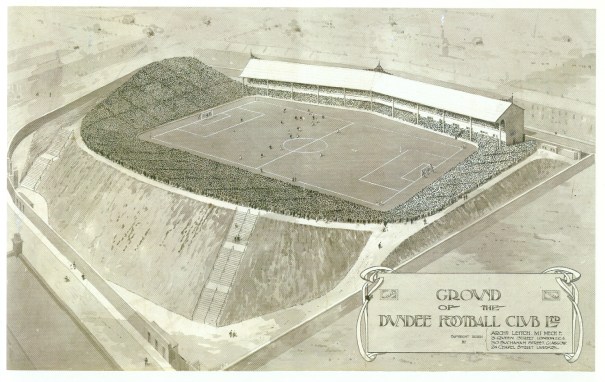 The explanation is probably that the terracing built on the sloping ground on the other sides of the pitch were not the same heights and widths. When they decided to cover the terrace, they went for a very basic cover on top of the existing terrace rather than constructing a completely new stand. And the irregular terrace (constructed on a sloping hill) was not wide enough for the stand in the western half of the ground.

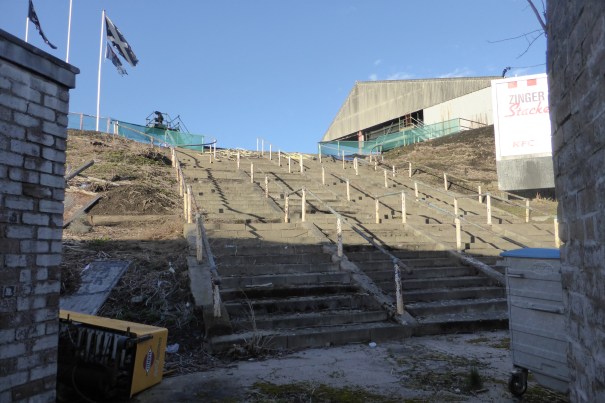 The reason why the match is played on a Friday night is, of course, that it is being televised. And that is also the reason why it has been easy to get tickets. The Friday night kick-off time hasn’t deterred the Aberdeen supporters. They fill the modern Eastern Stand with some 2.400 fans – out of a crowd of just 7.500.
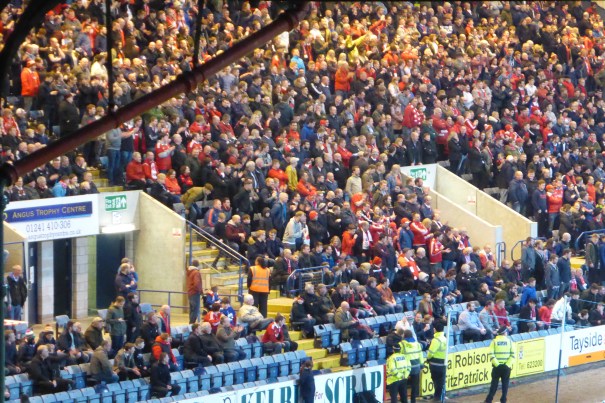 Predictably, it is also the Aberdeen supporters making all the noise. There are a few Dundee chants coming out from the southern stand, but they seem rather halfhearted. It is not that Dundee F.C. supporters don’t care. Back in 2010, when the club for the second time was put under administration because of financial problems, the supporters rallied and helped the club survive. In fact, the team also rallied after the club was deducted 20 points and had -11. But a long winning streak saw them survive the drop.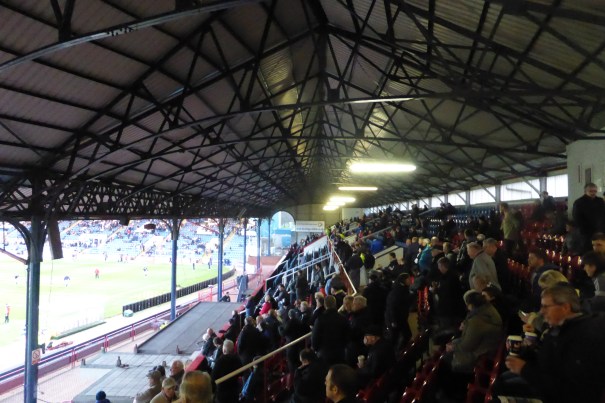
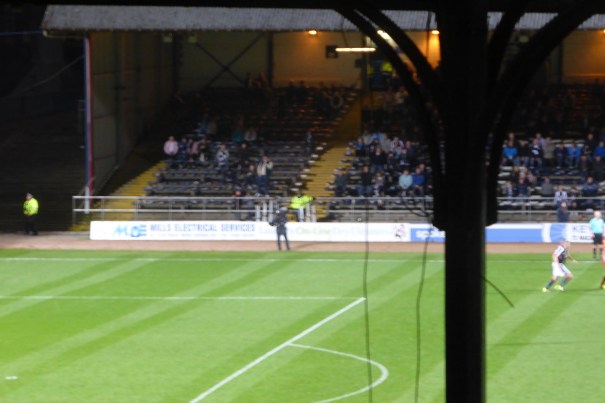 Most of the Dynamo players are disappointed by this lack of support. I try to put up a defence for the Dundee fans. When you really care, your heart is bleeding, whenever you watch such a collapse, and it is unbearable to see the wild celebrations among the rival away supporters. They stayed while it was only 2-0. because there still was – in theory at least – a chance that they could rally the team to get back into it. But now – it is just painful.


 We make our way back to the station. It is, fortunately, downhill. We come across a group of four elderly ladies with walking sticks and walkers. They mumble something about football, and I tell them that we were at the match. One of them ask for the score. Reluctantly, I tell her that Dundee F.C. lost 7-0. “I knew it!” she laments, whereas some of her friends express their disbelief.

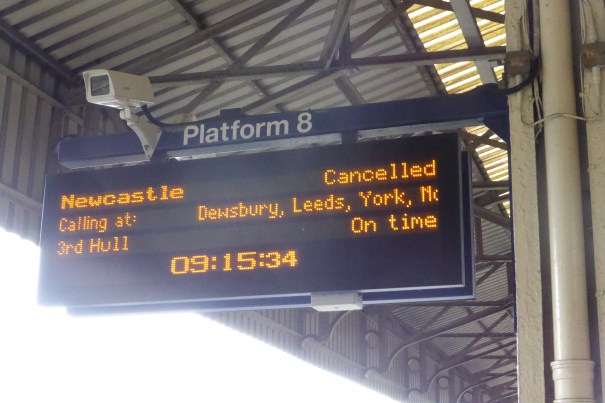 Next train for Newcastle is 11.18 – and as I have to check-in my suitcase in Newcastle before going on to Sunderland for the afternoon kick-off, what looked like a nice quiet Sunday, suddenly appear stressful. There is, at least, a lady in the otherwise empty station. “I have a ticket for the 9.18 to Newcastle”. “Well, that has been cancelled”, she says in a way that makes it sound as though it is quite normal.
 We get to Newcastle and cross one of the impressive bridges over the river Tyne, before reaching the station at 12.20. Newcastle really looks a nice place. As we proceed along the station platform, one of the older City supporters, almost as tall of me, takes a photo of the impressive ceiling of the station with his smartphone. The others laugh at him. “He is playing tourist!” He protests. He just thinks that it is beautiful. They laugh even more.
 It is a 25 minutes’ ride on the train that takes me to the centre of Sunderland. It is 1.30, 2 and half hours to kick off. By now, I am desperately hungry and thirsty, and as I see a nice little restaurant just before the Wearmouth Bridge, I decide to have a proper meal before venturing out on the bridge. I don’t like heights.
 It is 20 years since Sunderland moved to the Stadium of Light from their old ground Roker Park. They have really made a great effort to make it their new home. In the streets leading to the ground, the traffic posts are red and white with Sunderland badges, banners with former players’ names hang from the streetlamps, and huge billboards relive great moments in Sunderland’s recent history.


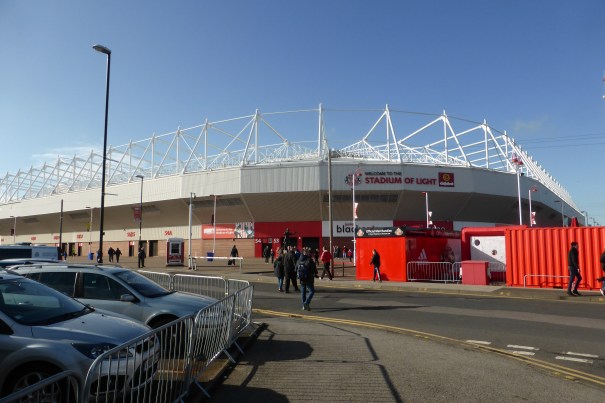 Whereas stadiums from the early 90s such as Millwall’s, Wigan’s, Stoke’s and Huddersfield’s consist of four separate stands, the Stadium of Light is built as a very harmonic, giant bowl. Even though two of the stands have been extended, it still is very harmonic to look at. After a short visit to the club shop, I enter the East stand.

 Fans are busy watching the Tottenham-Everton match on the screens. Despite not really being hungry after my meal at Elizabeth’s, I decide I just have to taste the pies in such a good-looking place. I go for the steak ‘n ale pie, and it is pretty good.


 As the players enter the field, a huge banner with a Jermaine Defoe picture is unfolded in the South stand. The PA system turns to Elvis Presley “Cant’ help falling in love with you” and the crowd joins in on the chorus.


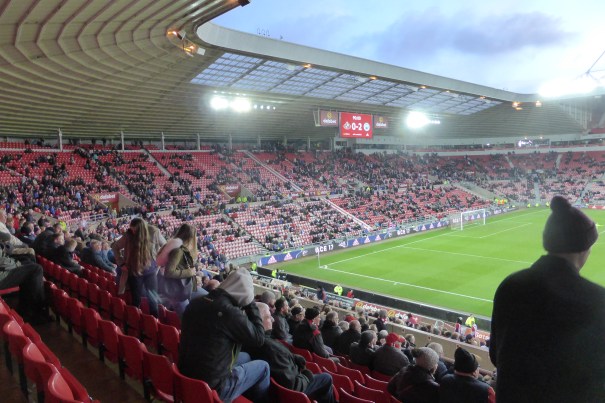 So, I wait for the train, and the security man is right. There is plenty of room in this, and it only has one stop before Newcastle. I am about to have a look at the match day programme, when a drama starts to unfold in the seats on the opposite site of the aisle. After showing the conductor his railcard, somehow, a young man manages to drop it – and it falls down through the gaps into the heater.


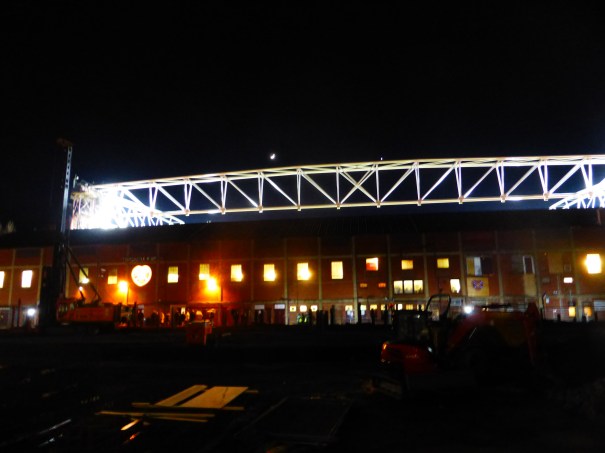
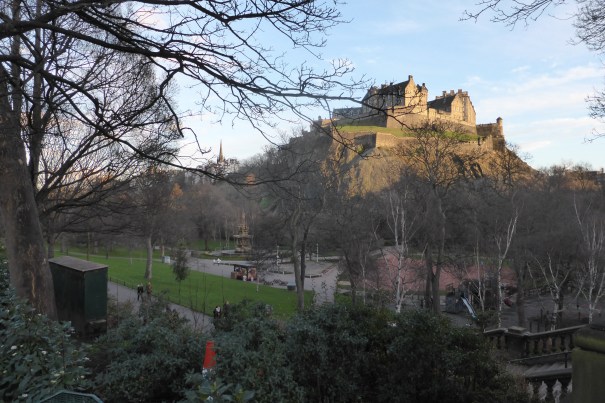


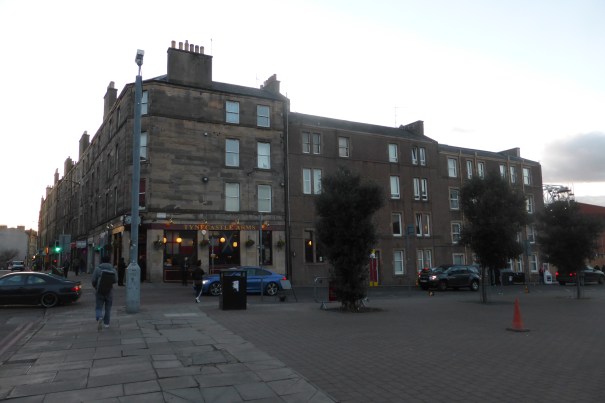
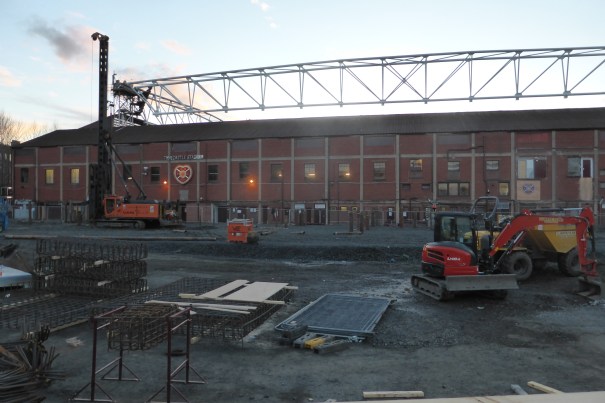


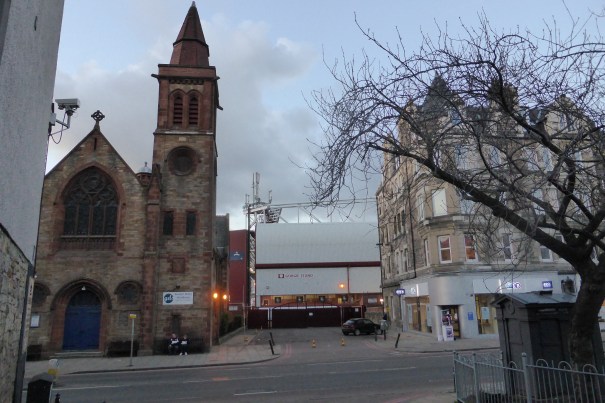


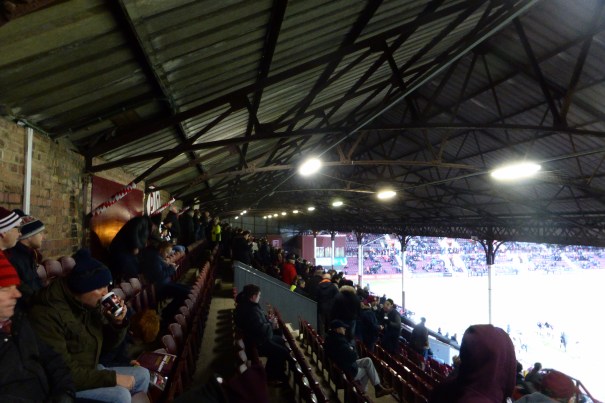


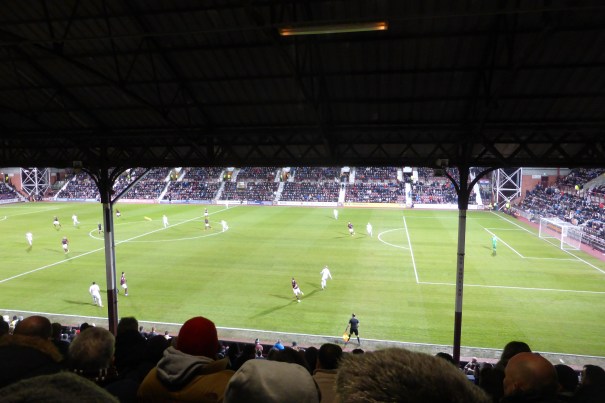


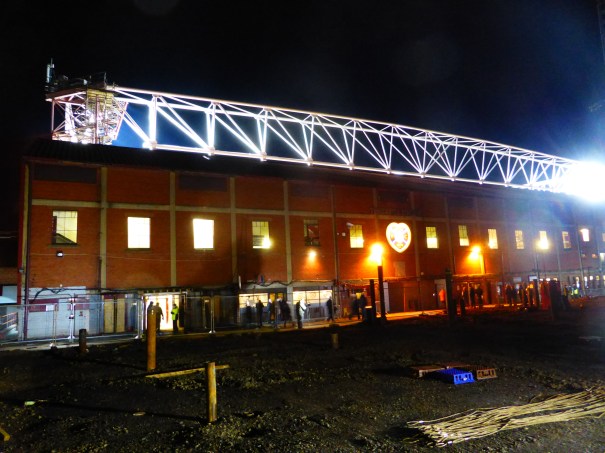


 Football and material culture